
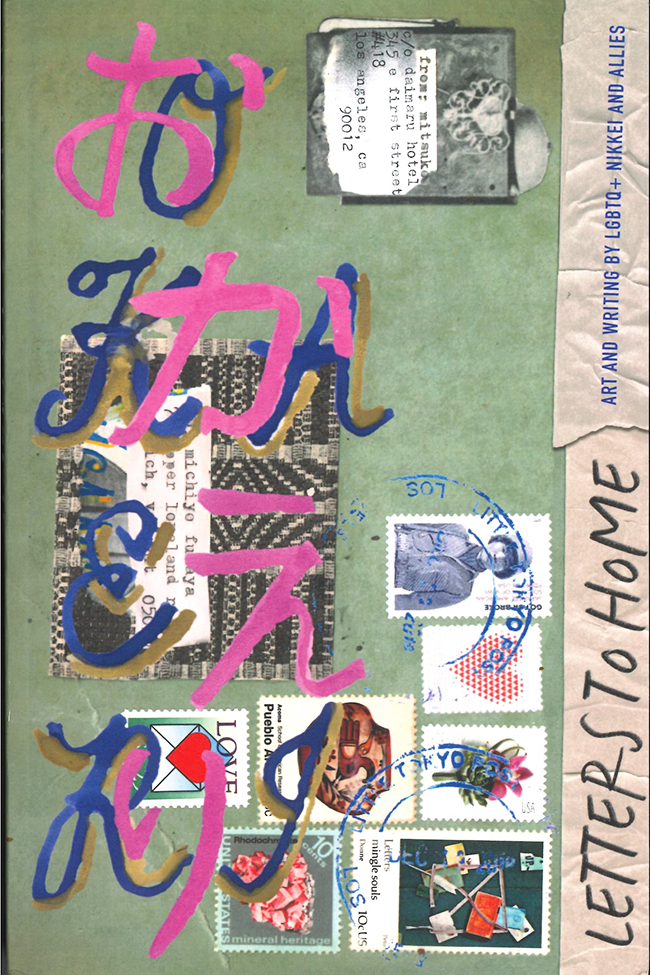
Letters to Home: Art And Writing by LGBTQ+ Nikkei and Allies
Edited by Michael Matsuno, Cody Uyeda and Rino Kodama (Los Angeles: Okaeri, 2024, 294 pp., $40, paperback)
A collected volume, “Letters to Home: Art And Writing by LGBTQ+ Nikkei and Allies” (2024), presents multiple genres of essays, poetry, and art by 42 authors who gather in the literary and art project of the Los Angeles-based community organization called Okaeri.
Since Marsha Aizumi founded the organization slightly over a decade ago, Okaeri has advocated for LGBTQ+ Nikkei. The Japanese word “Okaeri,” printed on the front cover of “Letter to Home,” clearly conveys the book project’s mission to create a sense of home — welcome for the community.
Home can be a physical and mental space that is fluid and changes over the years, as Michael Matsuno points out in the introduction: “No two individuals agree entirely on a stable definition of home, nor the feelings it evokes” (pp. 16). In this sense, the book project, “Letters to Home,” is an imaginative home that the contributors collectively create through writing and art.
The anthology consists of six chapters themed “Welcoming,” “The Earth and the Body,” “Reflections of Pride,” “Self-Portraits,” “Where We Find Home” and “The Imperfect Practice of Parenting and Allyship.” All the works composed in the anthology are filled with authenticity, honesty and bravery. Among stories about coming out and being sexual minorities, it is notable that multiple authors narrate their experiences of being denied and discriminated against in the Nikkei community.
The mistreatment of LGBTQ+ Nikkei in the community reveals its closed-mindedness toward their own diverse people. Yet, at the same time, Japanese Americans are very much aware of and active in social justice because of the wartime mass incarceration. “Letters to Home” accomplished something incredible by exposing the still-remained homophobic nature of the Nikkei community that has not been sufficiently discussed and criticized.
Intergenerational and multilingual aspects of “Letters to Home” make the book project unique. The anthology features multiple essays written by parents of LGBTQ+ Nikkei individuals. Their support for their children, as expressed in those writings, enforces the welcoming space that “Letters to Home” aims to create. In the essays by Reiko Yokota Barnett and Mia Barnett, listed back-to-back, the reader would have a sense that mother and daughter converse with each other through separate yet connected writings.
Japanese essays, although fewer in number than English ones, collected in the anthology, show the linguistic and demographic diversity within the Nikkei community. “Letters to Home” preserves the vulnerable and honest feelings expressed in Japanese, as well as nuances that are difficult to translate into English, such as Hatsu Keith’s tanka poetry. Bilingual essays, such as those by Tsukuru Fors, Momo Hoshi and Stacia Kato, reach out to a broader audience that may understand only one of the two languages, either Japanese or English.
The Japanese phrase okaeri, meaning “welcome home,” evokes nostalgia that guides you back to its origin. But the belonging that “Letters to Home” suggests fosters a futuristic space where LGBTQ+ Nikkei and allies can stay together.




Leave a Reply