
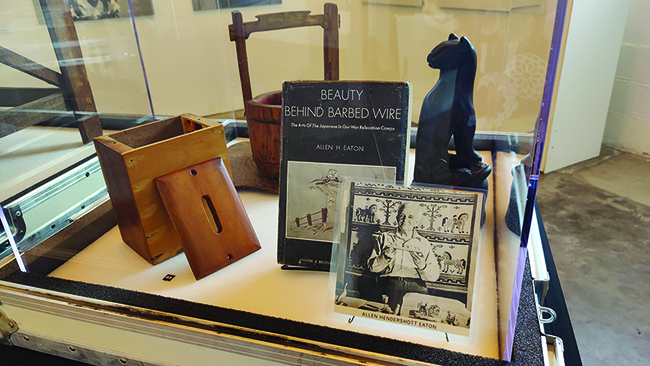
When some 400 artifacts from the Japanese American concentration camp era went up for auction in 2015 at the Rago auction house in Lambertville, N.J., the Japanese American community protested. Spearheaded by advocates, including the Earle K. & Katherine F. (Muto) Moore Foundation, the “Japanese American History: NOT For Sale” Facebook page, the Heart Mountain Wyoming Foundation, and actor
George Takei, the Japanese American National Museum ultimately acquired the Allen Hendershott Eaton Collection and became its stewards.
“When we did receive everything in 2015 there was no ledger or provenance or checklist or anything. It was just stuff, so if you can imagine going to your grandparents house, and going into the garage, basically there was no history,” Clement Hanami, JANM’s vice president of exhibitions and art director, told the Nichi Bei News.
Eaton’s collection includes many small crafts such as bird pins and name plates from barracks carved from scrap lumber, as well as photographs of inmates and their creations. Eaton, a scholar of American crafts, initially amassed the collection with the intention to hold an exhibition of camp artifacts alongside his 1952 book “Beauty Behind Barbed Wire: The Arts of the Japanese in Our War Relocation Camps,” but much of the context he knew of the objects was lost when he died in 1962.
More than half a century later, JANM, through a decade-long tour of the 100 objects and 300 photos in the collection, has pieced together more context for the collection and is now embarking on a second iteration of the exhibit to share what it has learned over the last decade.
Following an exhibition that concluded in January of this year at the museum in L.A., the traveling exhibit makes its first stop in San Francisco at the MIS Historic Learning Center in San Francisco’s Presidio.
“I think that the approach, which was a good one, is it’s not going to just stay in a vaulted basement, concealed for years, … make it accessible to the community that rallied and supported it, so that was a nice gesture, to make it go around,” Rosalyn Tonai, executive director of the National Japanese American Historical Society which is hosting the exhibit in its Presidio gallery space, said.
According to Hanami, this is not the first time the collection has visited the Bay Area. After the collection was initially on display at the museum in Los Angeles, the collection also first traveled to San Francisco in 2018 to hold a two-day pop-up event at the Japanese Cultural and Community Center of Northern California, and continued on to visit the Tule Lake and Minidoka pilgrimages.
“I’ve traveled it to 17 locations as a pop-up for like, two or three days. The longest, maybe a week in Chicago — with the goal of putting the artifacts and photographs in front of mostly people that we felt could help us, which were the former camp survivors, and knowing that they were octogenarians and older, they would not be able to come to L.A., so we knew we had to go out to them,” Hanami said.
The collection, which temporarily stopped its tour during the pandemic shutdown, continued to travel around the country as recently as 2023 in Costa Mesa, Calif., going as far north as Seattle and as far East as New York and Seabrook, N.J. to find some 50 connections that gives further context to the collection.
Hanami said he drove 12 hours to make the Minidoka pilgrimage while a stop in Colorado elicited a woman’s memory of meeting Eleanor Roosevelt. He was also amazed to see 3,000 people attending the Las Vegas Obon, where he set up shop in a gymnasium.
“Our budget was for like 12 locations, I think, but because of the way we were able to stretch the dollar, we actually ended up going to 17.”
While the 400 pieces in the Eaton collection remains intact at the museum, Hanami said the added context he has learned from the larger Japanese American community has helped expand the museum’s collections over the years, such as through a photograph of a wooden carving by Takeshi Ideta. The collection initially only possessed a photo of the carved a name-plate for Ideta’s family barracks, but Hanami met with descendants in Little Rock, Ark to see the actual carving, which the family ultimately donated to the museum.
“It kind of enhances the collection in that sense that it continues to grow kind of sideways, like it has a new story, but it’s connected to this story of us traveling to all these locations to try and connect people with the objects. It’s been quite a journey,” He said.
Hanami said he was aware that the first-person voices of those who survived the camp experience are quickly disappearing today and felt the objects now serve as an important connection for younger generations to the wartime history of Japanese Americans.
While Hanami noted there were various objects such as dresser drawers, name plates and even works by painter Estelle Peck Ishigo, he noted the Homma chair is one of the most iconic items on display. The chair “illustrates the struggles, but also the creativity, the utilitarianism, the mottainai nature of being Japanese American,” using scrap lumber and knotty wood to construct a functional object.
Hanami said Nancy Ukai, who led the protest against Rago through the “Japanese American History: NOT for Sale” Facebook page, researched the history of the chair.
Ukai said she was grateful for JANM for keeping the collection together and away from the highest bidders, and for finding ways to continue sharing it with the wider community. She added that people continue to sell artifacts from concentration camps today. A German auction house canceled a sale of Holocaust items after public outcry just this week.
“War trophies are not a legitimate item for commerce, to be sold to the highest bidder, any more than Nazi memorabilia should be auctioned,” she said.
The exhibit will remain at the San Francisco Presidio until Jan. 10, 2026 and then plans to travel to Oberlin College in Oberlin, Ohio following that, according to Hanami.
“Contested Histories: Preserving and Sharing a Community Collection,” a JANM Traveling Exhibit will remain on display at the MIS Historic Learning Center located at 640 Old Mason St. next to Crissy Field in the San Francisco Presidio through Jan. 10, 2026. The museum is open Fridays through Sundays from noon to 5 p.m. Admission is $15 or free for National Japanese American Historical Society Members.

Tomo Hirai is a Shin-Nisei Japanese American lesbian trans woman born in San Francisco and raised in Walnut Creek, Calif., where she continues to reside. She attended the San Francisco Japanese Hoshuko (supplementary school) through high school and graduated from the University of California, Davis with degrees in Communications and Japanese, along with a minor in writing. She serves as a diversity consultant for table top games and comic books in her spare time.




Leave a Reply