
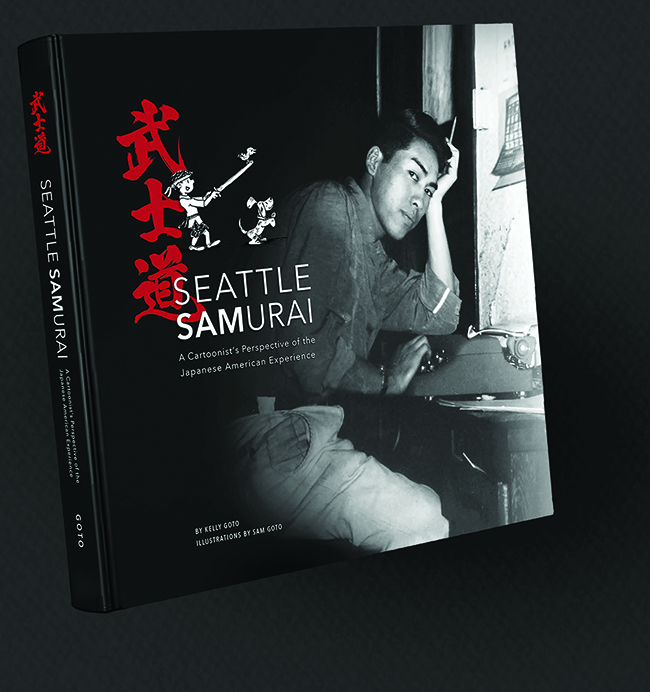
Seattle Samurai: A Cartoonist’s Perspective of the Japanese American Experience
By Kelly Goto, illustrated by Sam Goto (Seattle, WA: Chin Music Press, 2024, 264 pp., $37.15, hardcover)
“Seattle Samurai: A Cartoonists Perspective of the Japanese American Experience” follows the work of the late Sam Goto, a Seattle-based dentist and cartoonist in The North American Post, Seattle’s Japanese American newspaper. The book is a hefty hardcover, with high resolution photographs, satisfyingly thick pages, and a 9-by-10-inch footprint, making it appealing for a bookshelf or a coffee table. It chronicles the work of Goto as a cartoonist, a second career encouraged by his wife, Dee Goto, with whom he also worked on the Omoide project, a writing and oral history project based out of the Japanese Cultural and Community Center of Washington.
“Seattle Samurai” takes its name both from Goto’s signature comic strip character, Shigeru Tomo, a Seattle-born Nisei based loosely on the real Shigeru Osawa, as well as Goto’s own fascination with bushido and samurai philosophy.
Consequently, the book is organized around eight essential values of the samurai inspired by the work of Nitobe Inazo in “Bushido: The Soul of Japan” (1899): Courage (勇 Yu), Integrity (義 Gi), Mastery (自制 Jisei), Respect (礼 Rei), Honor (名誉 Meiyo), Honesty (誠 Makoto), Loyalty (忠義 Chu or Chugi), and Compassion (仁 Jin). Though the values come from a romanticized view of samurai philosophy, they provide a memorable organization for the book and will appeal to those who look to such versions of history to find inspiration.
Each of the eight sections outlines pieces of Sam Goto’s life, historical details about Shigeru Osawa, parts of Seattle’s Japanese American history, and cultural aspects of the Japanese American community. Alongside the small notes and contextual paragraphs, written by Sam Goto’s daughter Kelly Goto, the real highlights of the book are the comics made by Sam himself in his strip “Seattle Tomodachi.”
This is not to dismiss the written narrative throughout “Seattle Samurai,” as it is well written and provides both interesting information and helpful context, especially for those who are not familiar with Seattle, Japanese American history, or Japanese American culture writ large. But, the book is primarily a celebration of Sam Goto’s work, and is strongest when one reads through and enjoys the cartoons with their idiosyncratic style and sweet characters.
The comic strips are very much in the style of daily “funnies” and provide a Japanese American homage to the likes of Charles Shultz and Bill Waterson, both of whom Goto noted as influences on his work. The humor is often subtle and understated, with punchlines coming often as observations from the main character’s loyal dog Inu.
They are perhaps most memorable for their celebration of Japanese American history in the Pacific Northwest and for everyday life within the community. Historic topics include the lumber town of Barneston and the establishment of Seattle institutions such Kokugo Gakko, Nippon Kan Theater, Pike’s Place Market, Uwajimaya and the Panama Hotel. Interspersed between these topics are discussions of celebrations like Hina Matsuri, Kodomo no Hi, cherry blossom festivals, baseball games, and food traditions familiar to Japanese American communities like making umeboshi and sake or hunting for matsutake mushrooms in the forests of the Pacific Northwest. The strips make the everyday culture of the Japanese America come alive and are delightful in their normalization of the words, topics, and history of the community.
“Seattle Samurai” is a sweet and sentimental celebration of the life and work of Sam Goto. As someone unfamiliar with his work before picking up the volume (and not from Seattle!), I found myself a little sad I hadn’t seen the comic strip as it arrived in the North American Post, following the little adventures of Shigeru, Inu, and all the characters of “Seattle Tomodachi” from issue to issue. Even so, I enjoyed seeing Goto’s unabashed love for his community that radiates from his cartoons.



Leave a Reply