
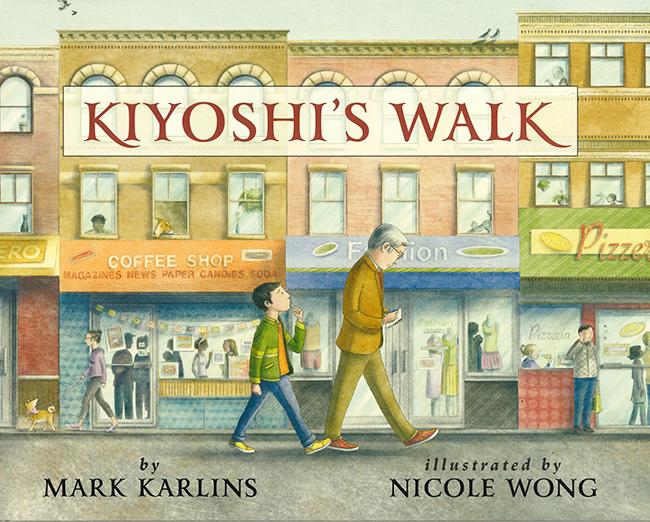
Kiyoshi’s Walk
By Mark Karlins and Illustrated by Nicole Wong (New York: Lee and Low Books, 2021, 32 pp., $19.95, hard cover)
 “Where do poems come from?” asks young Kiyoshi of his grandfather, the wise poet Eto, as he watched his grandfather write the short Japanese haiku-style poem:
“The dripping faucet
Takes me back to my old home
Raindrops on frog ponds”
Surprisingly, his grandfather answers Kiyoshi’s question with an eye-opening walk through the city.
To me, poetry is creative, filled with images created in the mind, expressive and can be thought-provoking. Although I don’t have any talent in writing poetry, I like reading and listening to it. I thoroughly enjoyed this book’s explanation of “What is poetry” and also admired the artist’s talent in bringing this out.
As Kiyoshi and his grandfather Eto take their walk, they stroll by a store on the corner where they use their eyes to see a cat knock down a display of oranges. They kept walking and then used their ears to hear a flock of pigeons flying overhead.
The two pass by an old house with a tall wall around it. Peeking through the wall, they see a stuffed bear on the ground and use their minds to imagine the story behind it. Finally, Kiyoshi and Eto reach a park by the river where Kiyoshi tells his grandfather he feels a little lonely when all the other playing children leave. Eto writes a short poem at each spot, capturing their experiences well.
“Now do you understand where poems come from?” asked Eto. Kiyoshi thought and answered. “They come from here, he said, and opened his arms wide to take in the river and the sky and the distant buildings.
“And they come from here, he said, and pointed to his own heart.”
Kiyoshi asked his grandfather Eto if he could write a poem, took a deep breath and wrote:
“In the cool spring night
The wind’s dance makes me shiver.
Your voice keeps me warm.”
Eto read his grandson’s poem. He smiled.




Leave a Reply