
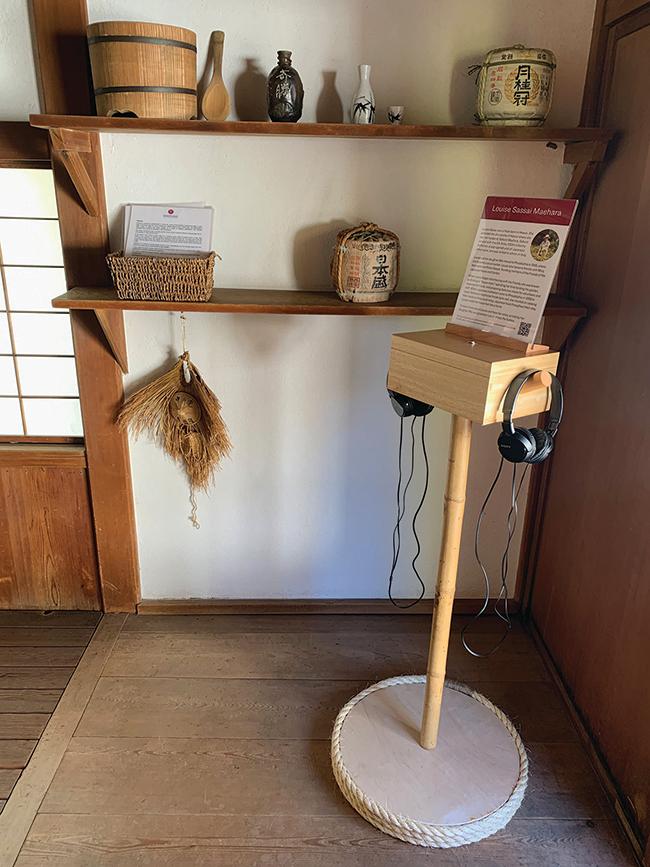
The history between the Philadelphia area’s Japanese American community and the historical Japanese house known as Shofuso located in the city’s West Fairmount Park, was nearly lost to time as many of the Nisei community stewards of the house and surrounding Japanese garden passed on at the turn of the century. The history, however, was rediscovered and is now on display at the Shofuso Japanese Cultural Center’s “Okaeri (Welcome Home): The Nisei Legacy at Shofuso” exhibit.
Rob Buscher, the exhibit’s curator, said the Nisei leaders were nearly forgotten not by malicious intent, but because of their modesty regarding their decades of work on the historic Japanese house and surrounding garden.
“The Nisei were so humble, they didn’t write about their own contributions to the space,” Buscher told the Nichi Bei News. “And so we were sort of left to our own archival resource, which they were incredible record keepers. They kept handwritten napkin and receipt notes related to all manner of things, and very detailed meeting minutes — to a certain extent, even the personal correspondence that some of them were having at the time.”
The archival sources informed Buscher, the former associate director of organizational culture at the Japan America Society of Greater Philadelphia, of the leaders of the Friends of the Japanese House and Garden, which served as the house and garden’s steward prior to the Japan America Society’s merger with them in 2016. Many of the organization’s heads included leaders within Philadelphia’s chapter of the Japanese American Citizens League, which played a major role in the 1980s Redress Movement.
The exhibit chronicles the journey the Japanese house underwent, first being built in Japan in 1953 and eventually being reinstalled in Philadelphia in 1957, as well as the Japanese American community’s experience, including the wartime incarceration and its aftermath, where thousands resettled in Philadelphia after the war.
“Our intent was to sort of create an opt-in experience, because we could assume from what we read about the Nisei and their intentionality with everything towards the space, the last thing that they would want was for us to interrupt the natural beauty of this site. And so keeping the exhibit within the house itself, but then also finding ways through the self-guided audio tour, to allow people to listen and learn more,” Buscher said.
The exhibit’s foundations started through an academic inquiry in 2017. Buscher, a Yonsei scholar and member of the Philadelphia chapter of the Japanese American Citizens League, was tasked with writing a historical account of the Nikkei community in the region ahead of the 2018 JACL National Convention in Philadelphia for the Pacific Citizen. The research on the Issei who first settled in the region connected Buscher to their children, which led to an exhibit he curated called “The Third Space: Japanese American Resettlement in Greater Philadelphia,” which was initially going to be a gallery exhibit, but became an online computer exhibit during the COVID pandemic.
Buscher, however, stumbled onto the deeply intertwined history of the Japanese American community and Shofuso that is the crux of “Okaeri” by chance, when he was perusing the Japan America Society’s archives in 2021 when he was hired by the society.
“I was vaguely aware that there were some Japanese Americans who had been involved with the space, but I thought it was at a pretty limited scale. It wasn’t until maybe my second week working at Japan America Society, in August of 2021 — I was looking in the archive room, just to kind of come up to speed — and I happen to on a folder of photographs, unlabeled, opened, just sitting there. And I looked inside and I recognized Teresa Maebori, who’s a Sansei leader in the JACL Philadelphia chapter, who’s now post-retirement, and she was maybe 30 in that photograph, and I saw her picture at an event. So I realized that there must be some story here.”
Further study led Buscher to board rosters and minutes from the 1980s, revealing many of the names involved with the Friends of the Japanese House and Garden were also Nisei leaders who had been active within the Philadelphia chapter of the JACL and key players in the Redress Movement.
With funding from the Japanese American Community Fund and the Aratani CARE Award, Buscher put together a team to curate the exhibit covering Philadelphian Japanese Americans and their ties to Shofuso, opening the exhibit in August of 2023 in tandem with the Japanese Culture Center’s Obon festivities.
“In a very literal sense, titling ‘Okaeri, welcome home,’ we’re inviting the spirits, we’re inviting the stories of the Nisei back into the space, back into the sort of community and institutional memory of Shofuso, back into the memory of Philadelphia to say that the Japanese American community has been here for a long time, has contributed greatly and continues to do so.”
Okaeri is currently on display at the Shofuso Japanese Culture Center located in the West Fairmount Park in Philadelphia. Tickets to the Japanese house and garden can be purchased at https://japanphilly.org/shofuso/. Shofuso is open through Oct. 27 from 11 a.m. to 5 p.m. and from Nov. 2 to Dec. 8 from 10 a.m. to 4 p.m. For more information on Shofuso, contact info@japanphilly.org or visit https://japanphilly.org/shofuso/visit/frequently-asked-questions/.

Tomo Hirai is a Shin-Nisei Japanese American lesbian trans woman born in San Francisco and raised in Walnut Creek, Calif., where she continues to reside. She attended the San Francisco Japanese Hoshuko (supplementary school) through high school and graduated from the University of California, Davis with degrees in Communications and Japanese, along with a minor in writing. She serves as a diversity consultant for table top games and comic books in her spare time.




Leave a Reply