
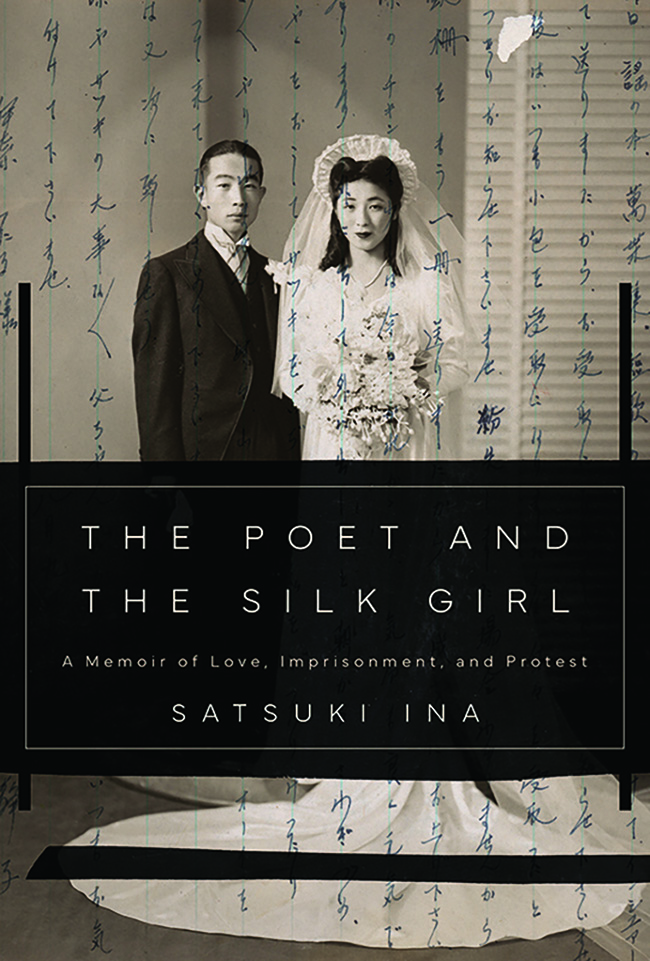
THE POET AND THE SILK GIRL: A MEMOIR OF LOVE, IMPRISONMENT, AND PROTEST
By Satsuki Ina (Berkeley, Calif.: Heyday Books, 2024, 312 pp., $35, hardcover)
Satsuki Ina’s book, “The Poet and The Silk Girl: A Memoir of Love, Imprisonment, and Protest,” presents a powerful account of one family’s experience of World War II incarceration, and the author’s efforts to reckon with the generational trauma that remains. In beautiful prose, Ina recounts her parents’ lives, born in the United States, journeying to Japan as Kibei-Nisei, meeting at the World’s Fair, falling in love and navigating the complex and punishing conditions of incarceration, internment and the threat of deportation. At the same time, she interlaces her own journey of self-discovery, bringing to bear her expertise as a psychotherapist, storyteller (Ina is the award-winning filmmaker behind the documentaries “Children of the Camps” and “From a Silk Cocoon”) and community activist (she is a co-founder of the organization Tsuru for Solidarity). What results is a moving account of the experiences and long-term impacts of forced removal and confinement, themes which resound with many Japanese American families.
The book comprises nine chapters, the first eight of which describe the various designations that Shizuko and Itaru Ina, the author’s parents, are given by the U.S. government: American citizens, non-aliens, disloyals, renunciants, enemy aliens, deportees, internees and alien residents. By arranging the book in this fashion, Ina emphasizes the impact that these categorizations had on her parents, forcing them to confront the transnational pulls of Japan and the U.S. as well as the betrayal of their rights by their birth country. Each subsequent reclassification is confronted by the Inas who attempted to navigate constantly changing rules and policies, often with only partial information.
Powerfully throughout the book, Ina inserts excerpts from her parents’ correspondence, her mother’s diary and her father’s poetry, providing firsthand accounts of this history.
The first two chapters describe Shizuko (née Mitsui) and Itaru’s upbringing in the early 20th century, including their meeting at the 1939 World’s Fair on Treasure Island, where Shizuko represented the Japanese Pavilion as a “Silk Girl.” Itaru, a burgeoning poet, worked at Nonaka Import and Trading Company in San Francisco and pursued cultural arts including performances in kabuki and composing haiku. Ina inserts some of her own poetry in these chapters as well as sweet love letters exchanged by her parents, a rare glimpse into young romance in the 1930s and ‘40s.
By the start of World War II (Chapter Three) the couple has wed, and as they are rounded up and imprisoned at the Tanforan, Calif. detention facility and Topaz (Central Utah) incarceration camp, they have their first child Kiyoshi.
With the disastrous “loyalty questionnaire” that is administered, Shizuko and Itaru grow increasingly disillusioned with the United States, and answer “no-no” to questions 27 and 28, causing them to be further segregated to Tule Lake where Satsuki herself is born. In the next three chapters, the couple is separated with Shizuko, Kiyoshi and Satsuki, remaining at Tule Lake and Itaru sent to internment camps in North Dakota and New Mexico. The bulk of these chapters follow Shizuko and Itaru’s correspondence as they try to decide what it means to renounce their citizenship and if a more stable future lay ahead in Japan rather than imprisoned in America. In chapters seven and eight the family is reunited in Crystal City, Texas, released to Cincinnati and subsequently returns to San Francisco. The short ninth chapter, titled “Healing,” serves as an epilogue of sorts, providing Ina with a chance to reflect on the impact the incarceration had on her own journey as both a psychotherapist and an activist, and the resonance of the incarceration with contemporary migrant detention.
Throughout the historical narrative, Ina contextualizes her family’s story, rejecting government narratives and euphemistic language, especially as she delves into the nuances of renunciation and “repatriation” cases. The extended use of her parents’ correspondence, often translated by Ina and Iko Miyazaki from the original Japanese, provides invaluable and contemporaneous insight into the inner thoughts and discussions that guided her parents through these fraught processes, something that only a small number of published and archival resources can provide. Especially striking are the secret notes sewn into trousers to evade censors and the coded language that the couple used to discuss their conditions.
“The Poet and The Silk Girl” provides a powerful and important account of the lesser-known aspects of incarceration. Written for a general audience (with few footnotes and no bibliography), the book manages to achieve great readability alongside serious analysis and new historical material. It is of note that the interior of the front and rear cover contains images well known to those who have viewed exhibitions on the World War II incarceration, one of Shizuko preparing for forced removal in San Francisco, and one of Itaru in the stockade at Tule Lake. In between these powerful and familiar images, the reader is introduced into the nuanced and under told stories of their lives and their legacies.





Leave a Reply