
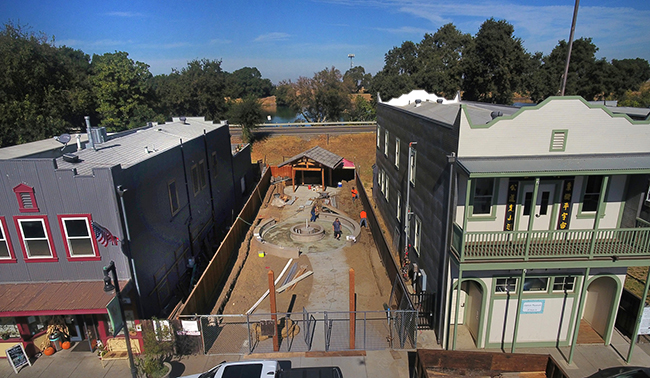
Isleton, Calif. is a small city of less than 1,000 residents situated along the Sacramento River. Like many towns in the California Delta, Isleton has a rich Asian American history, so rich that its Main Street was divided into two ethnic districts: a Chinese district and a Japanese district.
According to previous reporting in the Nichi Bei Weekly, by 1941, the Japantown had 12 boarding houses, five stores, two pool halls, three fish markets, two restaurants, a tofu store, barber, bathhouse, and liquor store. There was a Buddhist church, a Japanese school, a Christian church, and 10 other Japanese organizations.
Now, that history will be honored in the form of a beautiful park. According to Jean Yokotobi, president of the Delta Educational Cultural Society, the Asian American Heritage Park will be a place of learning and reflection.
“My vision is for people to come away with some knowledge, a sense of healing, and be able to communicate (their) feelings about (their) experience in the park,” said Yokotobi, a Sansei Isleton resident who helped restore two historical buildings in Isleton.
Located next to the recently restored Bing Kong Tong Building, visitors to the park will first be greeted by the park sign, which is designed to be “an exact replica” of the original sign for the Chinese Playground (which used to be where the park is now). Visitors will then take a curved path through the park, where they will immediately notice the sakura trees to their left, and a Japanese maple tree ahead.
Both sides of the pathway are lined with interpretive panels highlighting major Japanese and Chinese American historical events, such as Executive Order 9066, the Civil Liberties Act of 1988, the 100th Infantry Battalion and the 442nd Regimental Combat Team, the 1882 Chinese Exclusion Act, Paper Son, and the Alien Land Law. Yokotobi said each panel will include QR codes and technical links for more information.
According to the DECS Website, “The goal of this educational park is to stimulate some discussion with the younger generation about history, sacrifice, perseverance, and honor.”
The center of the park will feature a water fountain with an art sculpture and surrounding tile design by artist Yoshio Taylor. According to Yokotobi, the sculpture will feature the Chinese character for “playground park” (referencing the original Chinese Playground once again) and a bronze spiral with a fish shown to be descending along its surface.
The seat wall and benches encompassing the fountain will also be designed by Taylor and will feature Japanese and Chinese cultural symbols to “represent Isleton’s strong agricultural past and present,” said Yokotobi.
The park pathway ends with the Kansho-do, a shrine-like structure originally designed by the late Ray Takata for the Marysville Buddhist Church. The Kansho-do also houses a church bell donated by the Walnut Grove Buddhist Church.
Yokotobi established the nonprofit DECS in 2009 for the park’s creation. Though it has been 15 years in the making, Yokotobi said she “never gave up hope.”
“I think at times people did not understand the significance of the project, especially when you say ‘park.’ People would ask about picnic tables and barbecue pits for family gatherings,” she said. “Now people see this park and I can really see the excitement, not only personally but for the town of Isleton.”
Fundraising for the park is ongoing. They sold five commemorative benches already, but they still have many commemorative bricks to sell.
These engraved bricks will be placed in the pathway encircling the fountain art piece. Yokotobi said they also plan to hold fundraising events throughout the year, focusing on Asian celebrations like Japanese and Chinese new years, and Asian American Heritage Month, among others.
Such fundraising is also important because their grant requires them to sustain the park (covering ground and various construction maintenance) for 15 years.
Groundbreaking for the site took place in March 2024 and now they are in the final stages of construction. Yokotobi said they are waiting for signage and lighting before moving on to landscaping. She estimates the park will be complete in February 2025, with a grand opening the following April, in time with the sakura tree blossoming.
Yokotobi said she is proud of the support and excitement surrounding the park project.
“There are many people involved in this project, and all have a sense of passion for the project,” she said. “I also want to honor the original families of Japantown and Chinatown. This is their legacy.”
To view park construction updates, donate to the project, or purchase a commemorative brick, visit https://deltaecs.org/.




Leave a Reply