
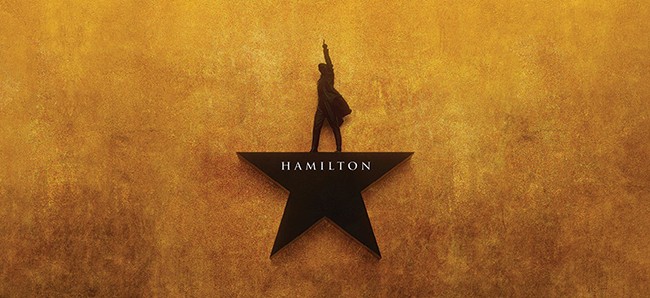
Kendyl Sayuri Yokoyama’s artistic journey from Nihon buyo to ‘Hamilton’
Anyone who catches the current tour of “Hamilton: An American Musical,” the record-smashing, medium-redefining runaway hit Broadway musical, is sure to take notice of Kendyl Sayuri Yokoyama’s performance as the female lead, Eliza Hamilton. It’s a role that requires careful modulation of stage presence — the character has a subtle, powerful arc that builds gradually, sneakily making Eliza an emotional core to the story by its end — and Yokoyama pulls it off expertly.
But Japanese American audiences are likely to, in addition to being captivated by her stellar performance, notice her Nikkei name and perhaps wonder about her heritage and its connection to her work.
The Nichi Bei News caught up with Yokoyama to ask her about that. And it turns out her craft and career have a profound connection to her family history and the Japanese American community in general.
In fact, her family even played a small, but critical role in Yokoyama’s audition for the Tony Award-winning musical penned by Lin-Manuel Miranda.
Then a 19-year-old student at Boston Conservatory at Berklee, she was in New York to try out for “West Side Story” when she saw that “Hamilton” was auditioning in the other room. She was not signed up, but wanted to be in the musical so badly that she got an idea: bluff her way into the audition.
“I’m very shy. It’s really hard for me to be bold, but I knew that if I didn’t do it, I would have really missed an opportunity,” Yokoyama, now 25, reflected. “So I called my mom and she was like, ‘Absolutely, go do it.’ And if I hadn’t done that, I wouldn’t be here … I definitely said quite a few white lies to get myself in the room.”
Her family’s influence, though, extends beyond occasionally encouraging a little creative fiction in the audition process. While Yokoyama is the first in her family to make art her primary vocation, her family’s connection to the arts runs deep — and it’s inextricably linked to their Nikkei heritage.
Yokoyama’s grandfather owned a movie theater in Los Angeles — the Kokusai Theatre — one of the small number of venues on the West Coast that screened Japanese films for the Nikkei community, and her parents instilled an appreciation for the arts in her and her twin sister, Jordyn.
“I grew up in Ventura County (California)… My dad’s a chemist and my mom’s an optometrist, but they both are very artistic in different ways,” she explained. “My parents love the arts. My dad is a big movie buff. And so I grew up watching movie musicals. I think all that exposure was really crucial.”
Yokoyama’s first formal arts training was in Japanese dance. Her mother is a longtime practitioner of traditional Japanese dance, Nihon buyo, obtaining the coveted, elite rank of natori and receiving a stage name and, more recently, obtaining shihan status, which qualifies her to teach.
“I’m so proud of her,” Yokoyama exclaimed. “(And grateful that) dance has been how we really tied ourselves to our Japanese heritage. I’ve been doing (Nihon buyo) as far back as I can remember, starting with the dances that all the little girls do, then getting to do the older girl dances later in life.”
She continued to practice Nihon buyo until she left for college and still has fond memories of performing.
“I remember being at a Japanese American event, possibly Nisei Week, performing with my twin sister and (actress Tamilyn Tomita) was there…. And my mom encouraged us to get her signature.”
Her parents are also responsible for a formative experience with musical theater, specifically, taking her to the 10th anniversary concert version of “Les Miserables,” in which Lea Salonga played Eponine.
“I will never forget that experience, I wanted to listen to [the soundtrack every day] in the car on the way back from school.”
Seeing Salonga in the role was powerful as well, in terms of representation for Asian Americans.
“I always assumed that Eponine was supposed to be Asian.”
Yokoyama started performing in musical theater at the age of 14, starting at Moorpark, California’s community theater, High Street Art Center. Her career since then has included participating in Keala Settle’s viral performance of “This Is Me” at the 2018 Academy Awards, and performing in a number of iconic roles.
But a particularly important role for Yokoyama was Peggy Maruyama in “Allegiance,” a musical based on George Takei’s experience of incarceration during World War II that connects to her own family history of wartime incarceration. While Yokoyama’s maternal grandparents were in Hawai‘i, and her paternal grandmother was in Japan, her paternal grandfather was incarcerated during the war in an American concentration camp.
“I’m Yonsei on my mom’s side, technically Sansei on my dad’s side, his parents were Kibei, but my jiichan came back to the States with his family, and there he was incarcerated, first at Santa Anita Assembly Center, Jerome in Arkansas and then Tule Lake eventually.”
Because her grandfather passed away when she was only two, Yokoyama didn’t get a chance to ask him directly about his wartime experience, although other family members mentioned that he had not been very forthcoming.
“He didn’t talk too much about the incarceration, and it was a very embarrassing time for him and his family, and it strained his familial relationships.
None of us actually knew that he went to Jerome until the ‘Ireichō’ came out at the Japanese American National Museum.”
Similarly, her family remains unaware of how he ended up in the Tule Lake Segregation Center, a maximum-security concentration camp where inmates from other camps who were considered “disloyal” or disruptive were segregated from the general Japanese American population.
“I’m assuming that he said ‘no-no’ to the questionnaire…,” Yokoyama mused. “I hope one day they’ll find some documentation.”
Although her maternal grandparents were not incarcerated, her grandfather enlisted in the U.S. Army and was in the all-Nisei 442nd Regimental Combat Team and the Military Intelligence Service, and his experience was well documented.
“He has amazing stories which my aunt has collected as memoirs,” Yokoyama said, sharing, in particular, that she has a fondness for stories that demonstrated her grandfather’s compassion and desire to avoid violence.
In one, he was in Burma and he and others were practice-shooting into some trees, and they realized that there were people within them.
“My jiichan stopped immediately, and then wanted to go check if they were OK, but it was getting dark, and as they were making their way back to camp, he let out his bullets one by one.”
The unloaded gun served as a symbol for a sort of quiet pacifism her grandfather practiced throughout the war.
“He was always surrounded by hakujin soldiers, who (doubted him) and he was like, ‘Look at my gun, I’ll use it if I need to,’ but it was unloaded and no one ever knew… if one day, I’m going to make a movie or series, I’d have that exact visual of him releasing his bullets one by one.”
Her performance schedule with “Hamilton,” of course, means that any such series would have to be in the future. But even “Hamilton” has brought her some surprising community connections.

photo by Andy Henderson
“There’s three (Japanese Americans) in ‘Hamilton’ now, actually, there’s Taeko (McCarol) and Sabrina Imamura,” Yokoyama explains. “And we have such different Japanese American experiences. (Sabrina) grew up on the East Coast [without as substantial a history of immigration and fewer community institutions], while Taeko grew up very Japanese, (including speaking the language fluently). It’s wonderful to have all three of us be together.”
The Asian American members of the cast have found meaningful opportunities to connect and build community over the years.
“We had like an Asian New Year’s Day. Everybody in the production at the time (threw a potluck). Our George Washington at the time, Marcus Choi, brought in a lot of yummy Korean dishes, everybody brought a little something from home.”
What did Yokoyama bring? The most iconic Japanese New Year’s dish, of course.
“I brought ozoni… There was no close Japanese American or Japanese supermarket (in Chicago) so I went to H Mart. I called my baachan and said, ‘If they don’t have this ingredient, what else can I get? It was my first time making it by myself.”
The performers have also had a chance to reflect, together, on what it means to be Japanese Americans performing on Broadway.
“The visibility that ‘Hamilton’ brings when all three of us are on stage is something that we’ve talked about,” Yokoyama explains. “The most rewarding part is to be able to meet Japanese American kids and adults that are so excited to see me (a Nikkei onstage). I’m just so grateful I get to do that for other people.”

Ben Hamamoto is a writer born and raised in the San Francisco Bay Area. He’s been published in the Oakland Tribune and has written for New American Media’s YO! Youth Outlook and the Nichi Bei Times. He is a research manager for the Health Horizons Program at the Institute for the Future. He also edits Nikkei Heritage, the National Japanese American Historical Society’s official magazine and contributes to Nichi Bei News.




Leave a Reply