
California is in crisis as home insurance providers pull out of the state due to intensifying impacts from climate change. Since the increased frequency of devastating wild fires, including the Camp Fire in 2018, which burned the town of Paradise, Calif. to the ground, insurers such as Allstate and State Farm have ceased writing new policies for the state.
The recent Southern Californian fires, causing an estimated $28 to $53.8 billion in property damage, according to the Los Angeles County Economic Development Corporation, have highlighted the crisis once again. Insurance providers such as State Farm General Insurance Company cited they had paid $1.75 billion on 9,500 claims filed over the recent wildfires and estimated a direct loss of $7.6 billion, calling on Ricardo Lara, the insurance commissioner of California, to let them raise rates to stay above water.
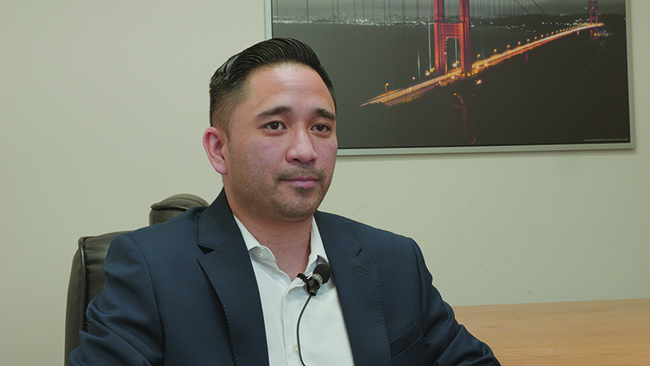
Because of these challenges, the Nichi Bei News consulted Brad Yamamoto, president of MIF Insurance Agency in Daly City, Calif., for advice on navigating the insurance market today. MIF, standing for its three founding partners Yoshiaki Moriwaki, Yuji Imai and David Fujita, started securing insurance policies for the Japanese American community, which struggled to procure insurance after World War II.
Yamamoto’s father Dick Yamamoto was the company’s fourth partner, who retired and passed the company down to his son in 2021. Brad Yamamoto, meanwhile, has worked at the agency for around two decades, servicing automobile and homeowner needs, as well as commercial insurance.
“We really haven’t changed the name, just because of recognition, recognition within the Japanese community in the Bay Area,” Yamamoto said.
While there are a myriad of things to consider, including how to find an insurance agent, Yamamoto said the choice comes down to personal preference on whether to go with an agent tied to a big insurer or an independent agent like MIF.
“Some people are just more comfortable going with a large insurance agent or insurance carrier just because of brand name or recognition. They trust it more,” he said.
“Some like the actual individual attention that they get from a local or independent agent. And really it just depends on your comfort level. I wouldn’t say there’s any really right or wrong answer.”
Choosing the right agent, however, is crucial while shopping for a policy, according the firm’s head.
“You really need to be able to trust that person that they’re giving you all the correct information, letting you know if your policy suits you and what exactly you’re looking at,” he said.
For example, Yamamoto said an agent could discuss “excess or surplus lines policies,” written by companies not admitted to California and not regulated by the state.
“That doesn’t mean that they’re not good insurance companies, but they do have … fine print or other possible sublimits on items of coverage,” he said “So really, you need to discuss with your agent as to whether or not that policy, again, suits you, or if you’re comfortable with certain aspects being either included or excluded on your policy. So again, I would say that having an agent you can trust is key to this, because they’re going to be the ones that are going to help you decipher the policy.”
While an agent can help assess the appropriate coverage needs based on location and size of a home, Yamamoto said one thing homeowners can do is to seek a higher deductible.
“One of the best ways to actually keep your insurance down, if you’re lucky enough to still have your policy in place, would be to seek out higher deductibles,” he said.
“And the reason being is that, the insurance companies are viewing kind of the small claims as negatives on your account, so the more small claims that you put in, the more jeopardy, you put yourself at risk of the company possibly not renewing you. So if you’re not going to put in these small claims anyways, you might as well take advantage of some of the savings.”
He said his clients are generally choosing a deductible of around $2,500.
Yamamoto added that he has not been free from the crisis, himself, as he had to replace his own homeowners insurance and re-evaluate what coverage he needed. He noted that insurers are tightening up their underwriting guidelines to limit the risk they take on, and said homes in the San Francisco Bay Area have faced more scrutiny because of their age.
“So like myself, when I had to apply for a new insurance company, I had to take pictures of my own home. So I had to go throughout, take pictures of the kitchen, the bathroom, things like that, in order to place my insurance, whereas years before, I would have never been asked that,” he said.
Fire danger also contributes to the difficulty as some insurance carriers are pulling out altogether from “high brush areas” or eliminating zip codes associated with these regions.
“So in those instances, people in those areas really have to be aware of their policies being in jeopardy,” he said. “The best way to go about that is to be proactive. Contact your agency, if there’s other possible insurance companies that might be willing to write it as a backup, and just shop around really at this time, because there are very limited markets available.”
Whether someone is looking for coverage on an older home they inherited or purchasing a new home for the first time, Yamamoto said they should consult an agent to find out the best plan and what kind of coverage is available.
“If you’re in the market and you’re looking for a new home, the first thing you should do is just reach out to an agent and just ask them, ‘hey, is this area able to be covered?’” he said.
While times are difficult, Yamamoto said he was not too confident the market will improve any time soon.
“There’s so many different working parts. There’s companies that are exiting California. There’s some that are putting holds on what areas that they’ll write in, some are still dipping their toe as to whether or not they’ll come back, but they’re putting tighter underwriting restrictions on these properties,” he said. “And then, in addition to that, the Department of Insurance is working on all these different state legislations that are trying to help it so that insurance companies are more motivated to write policies. But again, we don’t know how that’s going to really impact the market. So the best thing that we can hope for, really at this point, is for it to just kind of flatten out first and then kind of take it from there.”

Tomo Hirai is a Shin-Nisei Japanese American lesbian trans woman born in San Francisco and raised in Walnut Creek, Calif., where she continues to reside. She attended the San Francisco Japanese Hoshuko (supplementary school) through high school and graduated from the University of California, Davis with degrees in Communications and Japanese, along with a minor in writing. She serves as a diversity consultant for table top games and comic books in her spare time.





Leave a Reply