
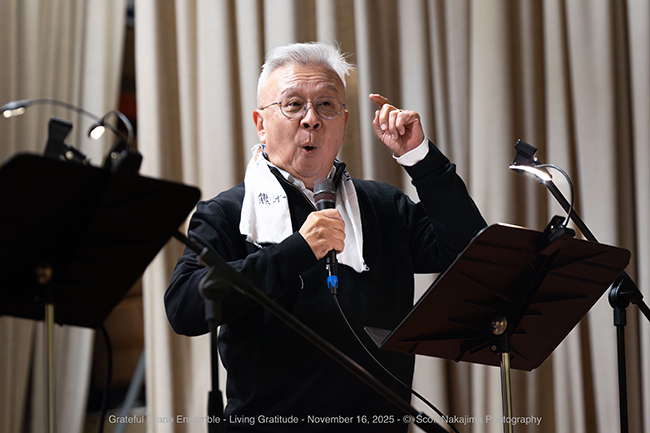
The Grateful Crane Ensemble performed “Living Gratitude: Buddhist Churches of America’s 125th Anniversary Show” at the Buddhist Church of San Francisco on Nov. 15. The church is the first Jodo Shinshu Buddhist temple in the continental U.S. and the flagship temple of the Buddhist Churches of America. The group also performed the show the following day at the San Jose Buddhist Church Betsuin. Both saw a turnout of more than 120 attendees, according to organizers.
Written by the Los Angeles-based ensemble’s executive producer Soji Kashiwagi, the show chronicles the 125-year history of the BCA through songs and vignettes performed by Haruye Ioka, Keiko Kawashima, Merv Maruyama and Ping Wu. The BCA commissioned the show as a way to celebrate the milestone.
“In 2023, Bishop Marvin Harada of the BCA contacted me and asked if I could write something in celebration of the BCA’s 125th anniversary,” Kashiwagi explained. “He wanted something historical, something musical — and could it be done in an hour?”
Rising to the considerable task, Kashiwagi weaved together historical events, experiences, and anecdotes drawn from sources like the BCA Centennial History Project Committee’s “Buddhist Churches of America: A Legacy of the First 100 Years,” “American Sutra” by Rev. Duncan Ryūken Williams, “The Making of American Buddhism” by Scott A. Mitchell, interviews with BCA members, and his own experiences growing up as a Jodo Shinshu Buddhist.
Given the richness of the material and the number of years covered, deciding what to include in the show and how to organize it was a challenge.
“I realized that BCA’s history is Japanese American history and JA history is American history. So I decided to focus on BCA history before, during and after World War II,” Kashiwagi explained.
“I wanted to include the racism and discrimination American Buddhists faced, along with the hate and religious intolerance they endured, especially with 17 temples ‘destroyed by fire’ throughout the BCA’s history,” he continued. “It hit me that this hate is the same hate that African American churches faced during the ‘50s and ‘60s, and Muslim American mosques faced after 9-11. I wanted JA Buddhists to see that they are part of a bigger picture, and what they went through continues to happen today which makes their story more relevant than ever.”
While the show is epic in its scope, it’s intimate in its details.
The narrative vignettes focus on a fictional family, the Yamashitas, a Japanese immigrant family with a small family farm (based on a real JA family, with a real family farm, in a real California town). It follows them from the founding of the BCA long before the war, practicing their religion under wartime incarceration, relying on the Buddhist church hostels after the war, and continuing to find faith and community in the decades that follow.
While it doesn’t shy away from the hardship and tragedy, the show is quite joyful, due in no small part to its music.
Selected by musical coordinator Kawashima, they range from broadly-recognizable tunes, like “Sukiyaki” (“Ue wo Muite Arukou”) and a parody of the Temptations’ “War,” to pre-war Japanese pop hits like “Shina no Yoru” most recognizable to Nisei and older Sansei, post-war gathas like Dharma school staple “Buddha Loves You” and “Ondokusan II,” a modern arrangement of a hymn written by Shinran Shonin himself.
Segments like “the Queen Bee of the Fujinkai” celebrate and affectionately poke fun at archetypical characters familiar to current and former members of BCA temples. And the vignette that chronicles the “chicken teriyaki wars” provides a delightful counterpoint to the actual war covered by the preceding segments.
Other vignettes focus on how church communities and ministers engage with not just large scale historical events, but the countless individual struggles, often life and death, that members of the sangha face.
At the San Francisco performance, while all eyes were directed squarely at the stage, it was clear from the reactions in the room, the audience felt deeply and profoundly seen. Throughout the show, there was plenty of laughter at even the most obscure of inside jokes, humming or singing along to the songs, and holding back, then ultimately wiping away, tears.
“As a Jodo Shinshu Buddhist myself, I knew that what I was writing was coming from personal experience and truth, and I was happy to see that our audiences have felt that,” Kashiwagi said, reflecting on the performance.
The show even culminates in a Bon Odori that the audience is invited to dance along to. At the San Francisco show nearly everyone did.
“Living Gratitude: Buddhist Churches of America’s 125th Anniversary Show” manages a remarkable balancing act, giving appropriate attention to both internationally-important and interpersonal histories, capturing both profound and mundane moments, joy and sorrow, tragedy and triumph.
“We were hoping that members and friends of all generations would consider this event at BCSF as a welcoming pilgrimage opportunity. As the first BCA temple, so many have walked through the BCSF doors at some point in their lives and we wanted this to be a joyful reunion for many and an inspiring gathering for all,” Julie Yumi Hatta and Misaye Abiko, event co-chairs, said in a statement.
They shared that attendees came from as far as Hawai‘i, Seattle, and Petaluma and they received many positive comments, including several from people who experienced the concentration camp years during World War II.
The San Jose performance drew a similarly enthusiastic reaction.
“Older attendees were enthusiastic in their appreciation of music that brought remembrances, while the younger members appreciated learning of BCA’s history in a delightfully performed program,” Reiko Iwanaga, event chair for San Jose, said.
“Many in the audience were very inspired and grateful to experience BCA’s 125-year history through favorite songs and familiar stories, many got teary-eyed at various points.”
“(Inspiring the audience) was what we set out to do,” Kashiwagi explained. “In the context of the BCA wanting to keep its temples alive into the future, I hope this inspiration turns into action.”
While the show was initially performed at the 2024 BCA National Council Meeting in Sacramento, Bishop Harada was so impressed by “Living Gratitude” that he and the BCA’s Dharma Forward campaign are funding a nationwide tour of this show, so that Jodo Shinshu Buddhists in each of the BCA’s eight districts will have a chance to catch it. Organizers are currently scheduling shows in Central California, the Mountain States and the Midwest.

Ben Hamamoto is a writer born and raised in the San Francisco Bay Area. He’s been published in the Oakland Tribune and has written for New American Media’s YO! Youth Outlook and the Nichi Bei Times. He is a research manager for the Health Horizons Program at the Institute for the Future. He also edits Nikkei Heritage, the National Japanese American Historical Society’s official magazine and contributes to Nichi Bei News.



Leave a Reply