
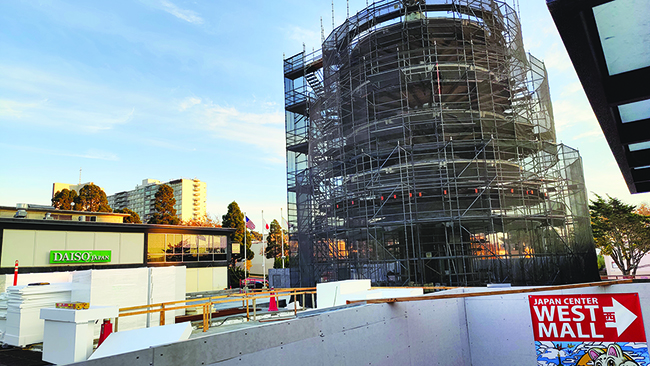
San Francisco’s Japantown finishes the year strong despite a year of construction on the Peace Plaza. As the community looks toward a new year, however, 2026 could go either way for its businesses and community leaders who are preparing to navigate another wave of construction.
Osaka Way Renovation Worries
Construction woes remain top of mind for many merchants, especially those located on Osaka Way (also known as the Buchanan Pedestrian Mall). As a major renovation is planned to break ground in May, merchants, especially restaurant owners, are wary.
“Nobody wants to have dinner within the dust and noise,” Masao Kuribara, owner of Hinodeya and Soba Dining Sora, said. He said all of the restaurateurs along the street are expecting sales to go down.
Kuribara’s neighbor, Linda Mihara, proprietor of paper store Paper Tree, concurred, saying the city should take more care in mitigating the impacts from construction, especially the dust.
“I think all of the businesses need to have a commercial grade air purifier. I think that that would help, because we have to keep our doors open,” she said.
Project leaders from the city’s Department of Public Works, however, have said they can’t buy air purifiers for individual private businesses, and have rejected a request to use thicker plywood walls on the construction site, citing safety issues.
Still, as much of a challenge it will be for merchants, Mihara said the construction is needed and a long time coming — a sentiment echoed by Emily Murase, executive director of the Japantown Task Force, whose organization has led the initiative in partnership with the city.
“I think that’s the number one thing. I really want people to understand, this is a community-initiated, community-shaped effort, but that if they have complaints or concerns, to please come to us and we will work with the city to address them,” she said.
Community organizations like the task force and the Japantown Community Benefit District, are taking lead to convey community concerns to the city as the project moves forward. Grace Horikiri, the benefit district’s executive director, said she will have to wait and see how the contractor selected for the project will handle mitigation and go from there.
“I think once we see them put everything up, whoever the contractor may be, … that’s when we really start talking with the merchants and say, ‘OK, this is up, what do we need to keep the dust out.’” she said.
For Horikiri, however, the mitigation efforts are just one of the concerns her organization faces. Since land owners within the commercial core of Japantown voted to enact the CBD in 2017, their 10-year mandate is about to expire. Horikiri said the organization will seek to renew the CBD with land owners this year, campaigning on the message the organization has maintained cleaner and safer streets while promoting Japantown.
“But also, in order to keep on doing the work that we do, I think we also have to consider expanding our district as well,” she said, floating the idea the district could also expand to include residential buildings such as the Golden Gate Apartments or 1600 Webster to increase the assessment income the CBD works with to hire community ambassadors.
Meanwhile the Japantown Peace Plaza renovation continues despite a delay, which now aims to complete after the annual cherry blossom festival in April. Community organizations and merchants were especially concerned for the Japan Center East Mall, which had been particularly isolated by the construction site right outside their main entrance.
Susie Kagami, executive director of KOHO SF, an arts and co-working space organization operating out of the mall for the last two years, however, said the East Mall has also been doing better compared to the previous year. She noted her space alone has managed to attract some 8,000 or so people through events.
“The East Mall, people don’t walk through as much as the West Mall for sure, and Kinokuniya, but I do feel like it’s getting better,” she said, noting Japantown is just “hopping” as a destination.
Will the Boom Continue?
Other merchants agreed with Kagami’s sentiment as Richard Hashimoto, head of the Japan Center Garages, said they maintain the top spot among city-owned parking garages.
Mihara said her sales have continued to grow over the last few years, even as tariffs have increased the price of her imported Japanese papers. She said the construction impacts will be what make or break 2026 for her.
Merchants in the Japan Center West Mall and Kinokuniya Building also felt that running prosperity as some note the mall is so packed, they can barely walk around on weekends.
But while weekends are packed, Tokaido Arts owner Robert Hsu noted the malls were almost empty during the weekday.
“Like, what’s going on here, is there another pandemic?” he said, about a quiet Wednesday afternoon.
Still, as younger people have flocked to Japantown amid a Japan boom to seek out their fill of manga and anime, ramen and soba, Japantown’s economy has distinctly taken on a focus on tourism and cultural customers. Toshi Sueishi, a barber running Futaba Salon in the basement of 1600 Post St., said he was only able to keep his space open because another person agreed to share the space with him.
“Japanese people no longer come to Japantown. The consulate, everything is gone now,” he said in Japanese, remembering an era when the Japanese consulate once operated out of the Kabuki Hotel along with Sueishi’s shop, making Japantown a hub for Japanese nationals. “It’s become a Japantown where Japanese people don’t come, so it’s all tourists now. Businesses that cater to tourists are probably doing well, but folks like me, I need regulars at my shop.”
Development and Ownership Questions
Sueishi, who has worked in Japantown for 49 years, said he is concerned about his future, noting the building he occupies has also been up for sale for the last year. While he said he will continue to operate for now, he will likely return to Japan when he finally retires, citing his social security benefits alone won’t support him after retirement.
The commercial building Sueishi occupies, 1600-1610 Post Street, also known as the Seiki-Lee building, had initially been listed for sale in April, 2025 for $7.125 million. The price was reduced to $6.75 million last June.
Community organizations, such as the Japantown Task Force, discussed what they could do to potentially secure the building to maintain it within the community’s control, but no one has several million dollars lying around.
“I need to hit the lotto so I can buy these buildings,” Horikiri joked.
More seriously, Horikiri said she could only hope that whoever purchases Japantown properties in the future will be community-minded people who acknowledge and understand what it means to live or work in a cultural district like Japantown, which regularly holds festivals and cultural activities throughout the year.
Moreover, mega projects loom as San Francisco aggressively seeks to resolve its housing crisis.
Align Real Estate, which was in talks to take over the former Safeway supermarket parcel off the corner of Webster Street

Tomo Hirai is a Shin-Nisei Japanese American lesbian trans woman born in San Francisco and raised in Walnut Creek, Calif., where she continues to reside. She attended the San Francisco Japanese Hoshuko (supplementary school) through high school and graduated from the University of California, Davis with degrees in Communications and Japanese, along with a minor in writing. She serves as a diversity consultant for table top games and comic books in her spare time.






Leave a Reply