
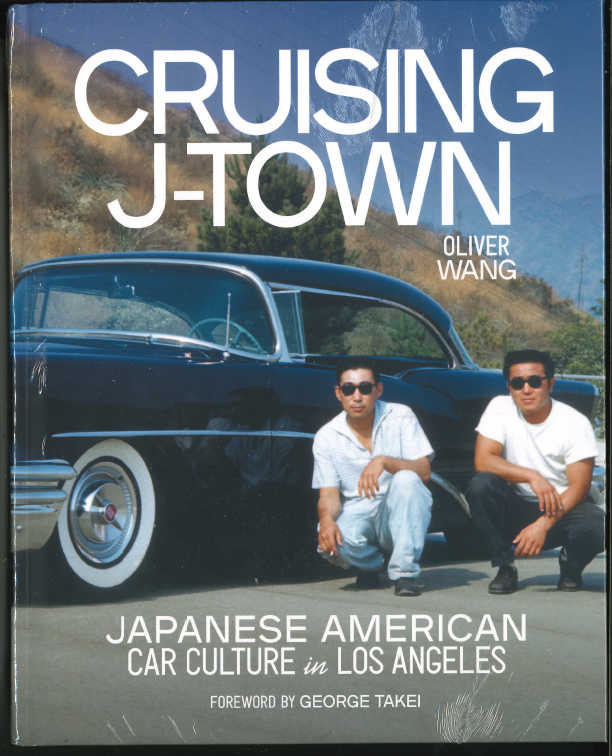
Cruising J-Town: Japanese American Car Culture in Los Angeles
By Oliver Wang (Los Angeles: Angel City Press, 2025, 272 pp., $50, hardcover)
When picking up the formidable “Cruising J-Town” by Oliver Wang, one can already get a sense that it deals with something pretty cool: cars. The book is a companion to an exhibit by the Japanese American National Museum that was hosted at the Peter and Merle Mullin Gallery in Pasadena from the summer to fall of 2025.
More than just a walkthrough of exhibition pieces, “Cruising J-Town” provides the first book which focuses on Nikkei car culture, with Los Angeles as its centerpiece. Boasting hundreds of photographs, the volume provides a look from the everyday to the glamorous and everything in between.
Four sections covering the origins of Nikkei car culture in Los Angeles, the World War II incarceration, the post war car culture of LA, and Nikkei contributions to contemporary car culture. The book opens with a forward by community luminary George Takei reflecting on his relationships with cars from family vehicles to early acting roles. Peppered throughout the book are short sections written by contributing authors on cars used for “voluntary evacuation,” trailer camp resettlement, fish trucks, freeway construction displacement, and drift racing (Chelsea Shi-Chao Liu), Nikkei auto designers (Oliver Otake), import car culture (Jonathan Wong), car audio systems (Akiko Anna Iwata) and Nikkei in motor sports (Kristen Lee).
The first section of the book is its shortest, outlining auto clubs and car related businesses led by Nikkei in early Los Angeles. This gives way to the second chapter which is centered around the forced removal and incarceration of Nikkei during World War II but also presents the vibrant and expansive car culture that was developing during the pre-war years. From hot rod clubs with fanciful names like “the Turtles” to speed racers in the Utah flats, Nikkei car culture during this period was vibrant, innovative, and expansive. The chapter further outlines the impact of forced removal, decimating businesses and disrupting a vibrant social culture around the car scene.
The third chapter covers the post-war period, perhaps the zenith of classic youth car culture in the United States (think “American Graffiti” but in LA and centered on Nikkei). Covering both the roles of automobiles in business — including gardening, auto shops and fuel stations — as well as car clubs, racing, and technological modifications and innovations. Chapter four rounds out the volume, bringing the book up closer to contemporary times, though stopping short of the present day. Its heart lies in the 1980s-90s including Nisei Week parades, street racing, import tuners, and intergenerational car love across families.
Although the book’s title may suggest a singular “J-Town,” the volume spans across the greater LA landscape from Little Tokyo to Pasadena, Gardena and Torrence to the Valley and the Inland Empire. If Wang and his collaborators continue, I would love to see some of the suggested areas of research touched upon in the epilogue explored including a larger focus on women and discussions of Nikkei car culture outside of LA.
As the first volume to tackle the subject, “Cruising J-Town” is as delightful and fun as it is informative. A wonderful addition to the library of anyone who was a gearhead, went to car shows, read zines on hotrods, played Initial-D, or had a first car that they remember fondly with love.



Leave a Reply