
Born Again Uchinanchu: Celebrating Hawaii’s Chibariyo! Story
By Karleen Chinen (Honolulu: Center for Okinawan Studies, University of Hawaii at Manoa, 2024, 352 pp., $48, hardcover)
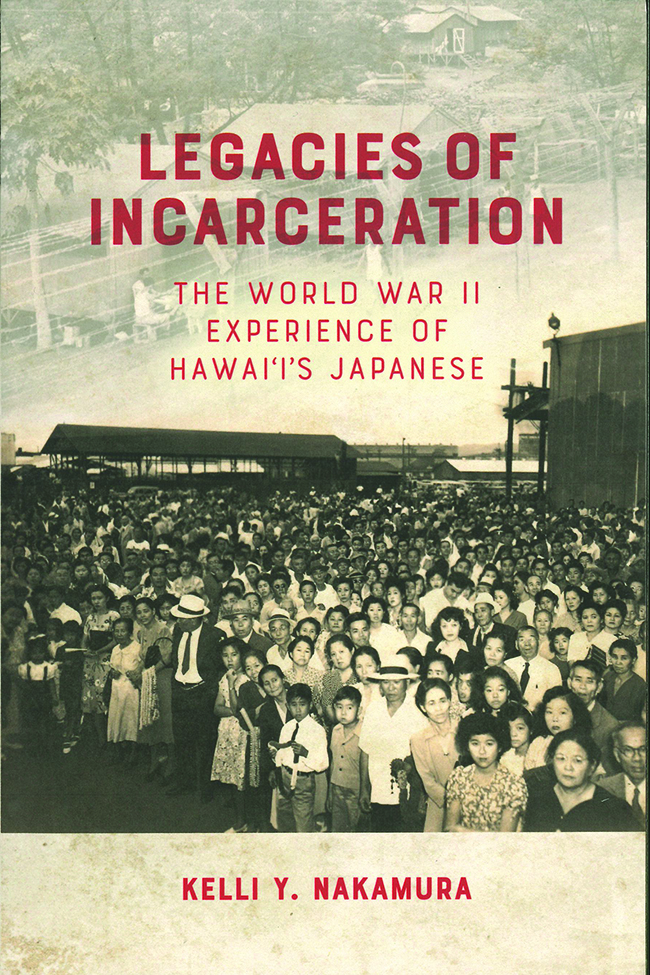
Legacies of Incarceration: The World War II Experience of Hawai’i’s Japanese
By Kelli Y. Nakamura (Honolulu: University of Hawai‘i Press, 2025, 232 pp., $26.99, paperback)
Two recent publications by Karleen Chinen, a journalist and former editor of The Hawaii Herald, and Kelli Y. Nakamura, professor of history at Kapiolani Community College, elucidate the diverse experiences of Nikkei communities in Hawaii. The historical records and community archives that Chinen and Nakamura examine are important since Hawaii is often underrepresented in dominant narratives of Japanese America and because Okinawan and Japanese American experiences continue to be conflated in Hawaii and the Continental United States.
Chinen’s book “Born Again Uchinanchu: Celebrating Hawaii’s Chibariyo! Story” focuses on Uchinaanchu or Okinawan community in Hawaiʻi, specifically the rise of the Hawaii United Okinawa Association. The visually rich book contains 10 chapters and more than 350 glossy pages filled with personal narratives and photographs, including one of my grandparents at the McCoy Pavilion in Ala Moana Beach Park where the first three Okinawan Festivals were held in the early 1980s. Chinen draws a parallel between the 26 Okinawan immigrants who first arrived in Hawaii in 1900 and the 37 Okinawan Americans who left Hawaii in 1980 to visit their ancestral homeland for the first time. This Hawaii Okinawa Study Tour proved to be so life changing that several participants returned home eager to preserve and perpetuate Okinawan culture in Hawaii. “Born Again Uchinanchu” chronicles the contributions of Sansei community leaders who worked to establish the Okinawan Festival in 1982 and to construct the Hawaii Okinawa Center in 1990. Other noteworthy accomplishments include sending representatives to the first Sekai Uchinanchu Taikai in 1990 and subsequent Worldwide Uchinanchu Festivals, commemorating the 100-year anniversary of Okinawan immigration to Hawaii, and supporting a longstanding Hawaii-Okinawa student exchange program.
In Uchinaaguchi, one of the endangered languages of Okinawa, chibariyo is an expression of encouragement that means “do your best” or “don’t give up.” This exhortation holds collective meaning shaped by multilayered histories of discrimination, forced assimilation, colonization, and military occupation. As suggested by the title, Chinen’s book aims to document and celebrate the Hawaii Okinawan community over a 20-year period from 1980-2000. “Born Again Uchinanchu” highlights the economic success of Okinawan-owned businesses like Zippy’s Restaurant and Times Supermarket.
Similarly, profiles of Gov. John David Waihe’e III, whose wife Lynne (neé Kobashigawa) traces her ancestry to Nishihara, Okinawa, and Gov. David Ige, who also traces his ancestry to Nishihara, highlight a 16-year period of Okinawan political influence in Hawaii.
As I read “Born Again Uchinanchu,” gratitude for the hard work and personal sacrifices of previous generations filled my heart. My grandmother, Janet Shigeko Kaneshiro, loved the Okinawan Festival, and my mother has fond memories of her dancing late into the night to the sound of sanshin music. It is thanks to organizations like the Hawaii United Okinawa Association that Okinawan culture in Hawaiʻi was reborn and passed down to Yonsei like me. Today, younger generations are working to cultivate their own sense of Okinawan identity. Many continue to practice Okinawan traditional arts while others work to build solidarity with Indigenous peoples across the Pacific. Several have also voiced concern over the lasting impacts of Asian settler colonialism in Hawaii and the presence of U.S. military in Okinawa. These varied pathways are possible because of the countless expressions of chimugukuru, translated by Chinen as “gifts from the heart,” that continue to connect Okinawan communities across the global diaspora.
Kelli Y. Nakamura’s “Legacies of Incarceration: The World War II Experience of Hawaii’s Japanese” argues that anti-Japanese sentiment arising from the plantation economy of the late 1800s laid the groundwork for the institution of martial law and the unlawful incarceration of Japanese and Japanese American community leaders in Hawaii during World W II. Building on seminal works like Gary Y. Okihiro’s “Cane Fires: The Anti-Japanese Movement in Hawaii, 1865-1945,” Nakamura resists narratives of Hawaii as a paradise exempt from racial and ethnic discrimination. By centering the experiences of the 2,270 Japanese who were imprisoned at an estimated 17 sites across the Hawaiian Islands, Nakamura makes a significant contribution to the study of Japanese American incarceration and World War II history.
While the forced removal of Japanese Americans on the West Coast of the United States and their incarceration during WWII, especially in the ten concentration camps operated by the War Relocation Authority, has been well documented by scholars, Japanese American incarceration in Hawaiʻi has not. Honouliuli Internment Camp on O‘ahu, the largest and longest-running incarceration site in Hawaii, was rediscovered in 2002. The site also held 17,124 Prisoners of War from Okinawa, Korea, Taiwan, Japan, and Italy, most of whom were noncombatants conscripted to fill labor shortages in Hawaii. Although still not accessible to the public, Honouliuli was recognized as a U.S. National Monument in 2015 and as a National Historic Site in 2019.
“Legacies of Incarceration” comprises five chapters that address ethnic discrimination in Hawaiʻi upheld by a dual system of justice, Japanese American experiences of surveillance under martial law, incarceration at Honouliuli Internment Camp and Sand Island Detention Center, the extension of military control on the outer islands and the lasting impacts of this history on the Japanese American community in Hawaii, including Nisei veterans.
Although the book is an academic monograph, Nakamura’s writing style is engaging and accessible to a non-specialist audience. Only a small percentage of Japanese in Hawaii were incarcerated, but the right to a trial by jury and the writ of habeas corpus were suspended for all under martial law. Those who were incarcerated were subject to interrogation, family separation, humiliating strip searches, and difficult living conditions characterized by mosquito infested quarters and squat latrines.
Japanese incarceration is often understood as the result of wartime hysteria, but the history of anti-Japanese sentiment in Hawaii, long before the bombing of Pearl Harbor, shows that elite white settlers and the U.S. military worked jointly to control Japanese Americans and to deprive them of basic civil liberties. The same parties who benefited from the illegal overthrow of the Kingdom of Hawaii in 1893 also sought to criminalize the Japanese for labor strikes, alcohol consumption, absenteeism at work, and the desertion of plantation contracts.
“Legacies of Incarceration” reveals connections between an extractive plantation economy and the blueprint for wartime incarceration. In a time when extralegal means are being invoked again to control and detain racialized communities, these histories matter now more than ever.





Leave a Reply