
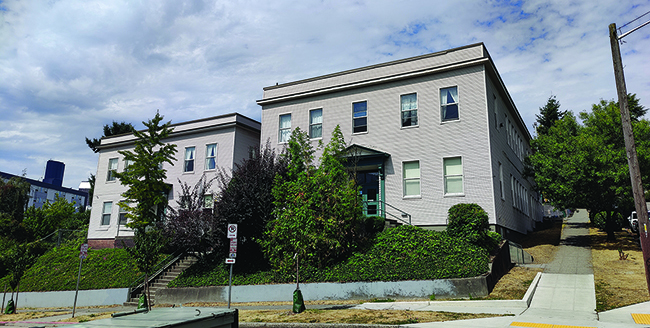
SEATTLE — While many in the Japanese American community around Seattle have moved out of the city over the years, its physical roots remain in the city’s International District and continue to thrive and evolve at the Japanese Cultural & Community Center of Washington.
In a community bisected by I-5, the more residential neighborhoods east of the freeway are home to Seattle’s Japanese Buddhist and Christian churches, as well as the community center. Housed in a three-building school built from 1913 through 1929 for the Seattle Japanese Language School, the JCCCW continues to host Japanese language classes and a Japanese language library, as well as cultural and historical repository of Seattle’s Japanese American community.
Beyond serving as a Japanese school, the complex has served a number of roles throughout the years. Before it became the community center, it was also known as the Hunt Hotel, a temporary residence for Japanese Americans after World War II and has since become home to the Northwest Nikkei Museum Collection, a building-wide exhibition on Seattle Japanese American history.
The JCCCW, as an organization, was formed in 2008 following the merger of the language school with the Nikkei Heritage Association of Washington.
“It’s a Seattle historic landmark, and it’s listed on the National Historic Register. One of the major things, in the merger agreement was, number one, we didn’t have to continue the language school, per se, but we did have to honor the legacy of the language school and the buildings, and offer language classes as one of our premier programs,” Karen Yoshitomi, the JCCCW’s executive director, said.
Today the school rents classroom space to the Bright Water Waldorf School on the weekdays and teaches 70 children Japanese language on Saturdays, although its students are mostly non-Nikkei.
“I think the Japanese American community is more … ‘diffused.’ It’s not as concentrated. I mean, in terms of people that come in for programming, they come from East Side, Bellevue, Issaquah, up the valley from Kent, Auburn, whatever. And so they’re not living in this area anymore,” Yoshitomi said. “Whereas everybody used to be within walking distance of church, school, and the businesses because we were in the red-lined district. But the community is now more spread out. And just like with the language school, our students are not predominantly Japanese or even Asian for that matter. It’s very diverse.”
Since the start of the pandemic, however, the school has also expanded to hold adult classes online, which Yoshitomi said has grown much larger due to its accessibility for students outside of Seattle, teaching 350 students over 31 classes and 18 teachers.
However, the JCCCW is active beyond the school. Thousands rely on the space each year as they come for annual events such as Kodomo no Hi (Children’s Day) and Bunka no Hi (Cultural Day). The building also hosts practices for a number of groups in its two dojo spaces on the ground floor. Yoshitomi said six taiko groups, as well as groups practicing Brazilian jiu jitsu, kyudo, shorinji kempo, karate, judo and even sumo meet in the building.
“So Budokan Judo Club is our main tenant in the large dojo, and they practice three times a week. They have a wait-list for their juniors class, so constantly a buzz on those evenings,” Yoshitomi said. “This past year, it’s been almost two years now, Rain City Sumo has started to use the large dojo for their practice, and they’re also growing. They just, in conjunction with the Cherry Blossom Festival this year, hosted the Pacific Northwest Sumo Tournament, which is the first one that’s been held here in this area for decades and they’re really excited about continuing it.”
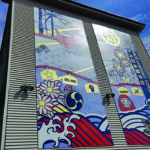
The building, however, is more than just a practice space and school. The oldest of the two school buildings has been renovated in recent years, and its breezeway has since become a corridor to conjoin the two buildings and house an elevator to make the complex accessible. Its walls are adorned with a collection of paintings by local Nikkei artists including Roger Shimomura, Aki Sogabe and Frank Fuji. Outside, the school hosts a large mural by Erin Shigaki and Kenji Hamai-Stoll.
Alongside the art, the Northwestern Nikkei Museum also attracts hundreds of visitors each year to see artifacts from the local Nikkei community, including a calligraphy piece by Hirobumi Ito, Japan’s first prime minister, who visited Seattle in 1901. Much of the structure is original to the century-old school building, and history is literally left scarred on the floors and walls.
Eric, who declined to give a last name, gave the Nichi Bei News a tour of the building during a visit in August, 2025. “This is our original floor,” the museum’s then-co-curator said, as he lifted a mat from the dojo’s floor. The wood, though polished, featured scorch marks from when the large room served as a communal kitchen and laundry room after the war.
“If you lift up the other mats, you’ll see basically where the water was and all the fire was because you’ll see the damage,” he said.
Yoshitomi likened the building to the Winchester Mystery House in San Jose. The old school building converted various rooms to other uses over the years by putting up and taking down walls and adding additions as needed.
“We have rooms inside of rooms, because it was all sort of built in phases. Addition, add another addition. Oh, we need a closet inside this room, so we’ll wall this up,” Yoshitomi said. “We discovered that there’s, I don’t know, it might be a five-foot wide space, 16 feet tall and about 20 feet back. … When we walked through the breezeway there, there’s a void on the other side of the wall that used to have a door leading into it.
Yoshitomi said she should consult the blueprints and have the space opened up for additional storage space.
“Yeah, kinda scary,” she said. “That and the ghost that we have. We do have a ghost.”
Yoshitomi did not elaborate on the ghost.
She did, however, talk about how the JCCCW has taken on more roles within the Nikkei community in Seattle over the years. The organization is currently in the process of taking over the annual Seattle Cherry Blossom & Japanese Cultural Festival, held annually in April at the Seattle Center. The three-day event alone attracts 20,000 people.
“One of the original purposes of establishing the Cherry Blossom Festival … was to allow the general public, not only to be introduced to the culture, but meet people who are practicing the culture,” Yoshitomi said. “And so, in addition to Nihon buyo, Japanese classical dance, letting people know who the teachers are, and introducing them.
Or, we have the Seattle Go Center, who brings their members, and they teach people how to play go. But they also are advertising that, ‘here, we’re up in the University District, and if you want to come by and learn how to play or whatever, be a member.’”
For the rest of the year, Yoshitomi said she focuses on the community center’s physical space, managing staff and volunteers to run the second-hand Housekibako shop on weekends, and maintaining the 10,000-book Japanese language library for Japanese speaking visitors. All of those roles permeate and intermingle throughout the building, according to its director, like the scorch marks on the dojo floor or even the sound of taiko practice booming through the halls.
“They’re noisy. Our neighbors hate us,” she said with a smile. “(But) I think people get used to it … We kind of pride ourselves on the fact that it’s hopefully a welcoming place. It’s vibrant and it’s alive.”

Tomo Hirai is a Shin-Nisei Japanese American lesbian trans woman born in San Francisco and raised in Walnut Creek, Calif., where she continues to reside. She attended the San Francisco Japanese Hoshuko (supplementary school) through high school and graduated from the University of California, Davis with degrees in Communications and Japanese, along with a minor in writing. She serves as a diversity consultant for table top games and comic books in her spare time.



Leave a Reply