
 On Sept. 12, my Yahoo! feed listed two brief articles — one from Food and Wine magazine, one from First for Women — stating that the Centers for Disease Control and Prevention released its list of healthiest vegetables based on Nutrient Density Scores based on 17 essential nutrients; potassium, fiber, protein, calcium, iron, thiamin, riboflavin, niacin, folate, zinc, and vitamins A, B6, B12, C, D, E, and K. And surprisingly, the vegetable ranked number 1 with a perfect 100/100 score was watercress.
Because my undergraduate degree is in nutrition, I wanted to read the original CDC publication… which also surprisingly was published in June 2014. Oh well, referencing a publication that’s over 10 years old is a stretch, but the information is technically still valid unless farming practices for these vegetables has drastically changed over the past decade.
The CDC’s Nutrient Density Scores look at the bioavailability of iron, riboflavin (B2), niacin (B3), folate (B9), pyridoxine (B6), cyanocobalamin (B12), Vitamin C and K to calculate the Nutrient Density Score.
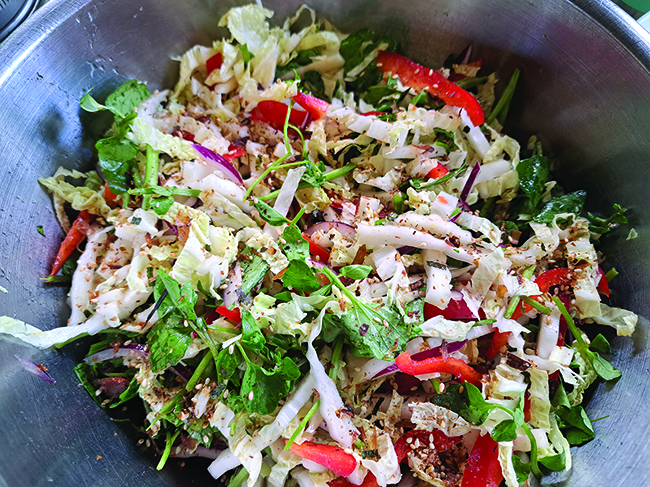
The following simple recipe uses the top two vegetables as far as Nutrient Density Scores go: watercress and Chinese or Napa cabbage. While the 50th has an ample supply of watercress via the fourth-generation of the Sumida family to run Sumida Farms, which supplies almost all of Hawai‘i’s watercress, you might have to search the Internet for markets in the Bay Area selling watercress. I know that the rest of the ingredient list is readily available in the Bay Area.
Cabbage and Watercress Salad
1/2 head (halved lengthwise) cut into 1/4-inch strips
1 bunch watercress cut into 2 to 3” pieces
1 red bell pepper, julienne strips
1/4 red onion, thinly sliced with the grain
Nori furikake
Asian Sesame Dressing:
1/4 cup vegetable oil
1/4 cup rice wine vinegar
1 1/2 tbsp mirin
3 tbsp sesame oil
1 tbsp reduced sodium shoyu
1 tbsp grated ginger
1 tsp miso
Place all the prepped vegetables in a large mixing bowl. Combine the ingredients for the dressing in a bottle, cap then shake. Drizzle then toss the vegetables then sprinkle with the furikake.
What About the ANDI Score?
The ANDI Score or Aggregate Nutrient Density Index assigns scores between 0 and 1,000 and is based on a food’s vitamin, mineral content plus the phytochemical and antioxidant capacities. Dr. Joel Fuhrman, who has published multiple books on diet, nutrient density and longevity, created the ANDI Score.
The ANDI Top Ten green vegetables are: Item ANDI Score
Mustard/Turnip/Collard Greens 1000
Kale 1000
Watercress 1000
Bok Choy/Baby Bok Choy 824
Spinach 739
Broccoli Rabe 715
Chinese/Napa Cabbage 704
Brussel Sprouts 672
Swiss Chard 670
Arugula 559
The Top Ten Nutrient Dense Veggies according to the Centers for Disease Control
Item Nutrient Density Score
Watercress 100
Chinese (Napa) Cabbage 91.99
Swiss Chard 89.27
Beet Greens 87.08
Spinach 86.43
Chicory 73.36
Leaf Lettuce 70.73
Parsley 65.59
Romaine Lettuce 63.48
Collard Greens 62.49
Stir fried?
Another nutrient dense dish you may want to consider is stir fried leafy greens, namely mustards or collards with kale, spinach, broccoli rabe and chard. All it takes is two to three cloves of thinly sliced garlic browned in a little olive oil, your leafy green mix and salt and black pepper to taste. The only issue with leafy greens is that they can cook down to almost nothing so you’ll literally need a five-gallon bucketful of these greens for several servings. And though beet greens didn’t make the ANDI Top Ten, I would also include them as they’re #4 on the CDC list. In fact, beet greens are simply the original progenitor of chard. The modern chard is simply strains of beets that produces heartier leaves than roots though given a choice, I’ll go with beet greens anytime, as they still maintain that hearty beet flavor, whereas chard has a nondescript lettuce flavor.
Just remember that for both the CDC Nutrient Density Score and ANDI Score lists, these are just vegetables that should be regularly included in your diet but they shouldn’t be the only foods in your diet as you still need carbohydrates preferably low glycemic index, proteins preferably lean animal or plant-based proteins and fats preferably from cold water fish, nuts, seeds and oils.
And though the CDC and ANDI nutrient scores are guidelines to feeding the body, you also must feed the soul, so it’s perfectly OK to occasionally enjoy a frisée salad tossed in a Dijon mustard vinaigrette and topped with crispy lardons and a perfectly poached egg with a glass of Pinot Noir. A votre sante!
Ryan Tatsumoto is a graduate of both the University of Hawai‘i and UC San Francisco. He is a recently retired clinical pharmacist and a budding chef/recipe developer/wine taster. He writes from Kane’ohe, HI and can be reached at gochisogourmet@gmail.com. The views expressed in the preceding column are not necessarily those of the Nichi Bei News.

The Gochiso Gourmet is a column on food, wine and healthy eating. Ryan Tatsumoto is a graduate of both the University of Hawai‘i and UC San Francisco. He is a recently retired clinical pharmacist and a budding chef/recipe developer/wine taster. He writes from Kane’ohe, HI and can be reached at gochisogourmet@gmail.com. The views expressed in the preceding column are not necessarily those of the Nichi Bei News.







Leave a Reply