

 No, I’m not talking about sugar-free Jello which gives me PTSD as the only time I consume sugar-free Jello is the day before a colonoscopy.
There’s another jelly that’s guilt free because it’s all dietary fiber. Made from the konjac plant; konnyaku.
Amorphophallus konjac
The plant that produces what eventually becomes konnyaku is a strange appearing piece of vegetation. It’s in the same family as the corpse plant sprouting a huge flower and if you recall your early Latin classes, the name means misshapen genitalia. Yes, this really sounds like a plant that produces something I really want to consume. But contained in the spherical corm or “root,” is a soluble fiber that produces a viscous jelly that makes konnyaku and shirataki. And because the fiber or glucomannan isn’t absorbed, konnyaku and shirataki are virtually calorie free with a 100 grams serving (a little over 3 ounces) having only 10 calories and almost 4 grams of fiber.
Creating an Edible Product
Like that other corm taro, konjac must be processed to become edible as it contains a fair amount of oxalic acid (like taro) which at the very least will give you an itchy throat and at worst kill you. The grated konjac corm is usually soaked in lukewarm water for several hours then treated with limewater. After the gel forms, it’s usually boiled for about an hour to further harden then simmered in a fresh batch of water to remove excess carbohydrates to obtain the final product. Sometimes hijiki is added to give the konnyaku a darker color or its left as is for a white hue.
Konnyaku
The first thing I think of with a traditional block of konnyaku is chicken nishime. I simply slice bite-sized cubes to slowly simmer with the chicken and other ingredients but Ms. S’ family made thin regular slices that were folded into an interior slit for a decorative bite of konnyaku. It’s also added to oden and nabe but my other application that I made more often than nishime was for our work lunches. I often cooked Napa cabbage with sliced daikon, shiitake, takenoko, fishcake and konnyaku in a “broth” (the water liberated from the cabbage formed the broth) flavored with shoyu, ginger and Hondashi.
Shirataki Noodles
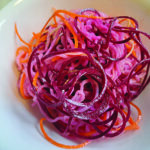
Shirataki is simply konnyaku that has been processed into noodle form. You can use it in the same applications as block konnyaku though it doesn’t make a great pasta substitute on its own as it still has the firm, consistency as block konnyaku so simply think of shirataki as long strands of konnyaku.
Konnyaku Sashimi
Many years ago when my Dad passed, as a traditional Buddhist custom, I practiced Shojin Ryori for the 49 days after his passing. Since the 49 days took me to Jan. 13th, it overlapped New Year’s Eve/Day when we normally indulged in sashimi during Oshogatsu. That’s when I found konnyaku sashimi at our local Marukai Wholesale Mart. However, that was well over a decade ago and Marukai no longer sells konnyaku marketed specifically to consume as “sashimi” though the simplest approach is to purchase a block of konnyaku — not the noodle-shaped variety known as shirataki — and simply boil it for a couple of minutes to remove the strong odor, let it cool then slice as you would slice sashimi. I usually serve this over grated daikon, grated fresh ginger with a ponzu shoyu.
Tofu Shirataki
Several years ago, I found a konnyaku-based product combining the firm texture of konnyaku with the neutral flavor of tofu that had a texture just like perfectly cooked spaghetti. You can use it in traditional Japanese dishes like nabe or nimono or create new dishes in place of traditional wheat-based noodles. Since the 50th is in the midst of our annual unbearable summer with temperatures in the high 80s and humidity approaching 80%, I made a refreshing “noodle” dish featuring this tofu shirataki along with a range of colorful vegetables also cut into “noodles.” The dish also used a kitchen implement Ms. S received a decade ago but the box never was opened (it had a shipping tag from Amazon dating back to November 2015). It was a contraption that used a circular cutting wheel to create vegetable “noodles.” While it didn’t really work — I ended hand rotating each vegetable because the crank never created enough pressure to slice the veggies making sure that I didn’t also make fingertip “noodles.” Amazon currently has handheld models complete with finger guards. After tossing the tofu shirataki along with daikon, carrot, zucchini and beet “noodles,” they were tossed with this dressing. The dish isn’t as colorful as I originally intended as the beet makes every ingredient pink. But if you’re pressed for time, you can simply toss with bottled roasted sesame dressing but this version refreshes the palate with a stronger vinegar kick.
Asian Sesame Sauce
¼ cup vegetable oil
¼ cup rice wine vinegar
2 tbsp mirin
1 tsp honey
3 tbsp dark sesame oil
1 tbsp shoyu
1 tbsp grated ginger
2 tsp white miso
2 tbsp Kewpie mayonnaise
Place all ingredients in a glass jar then shake until a uniform suspension is created.
So other than beating the heat with this refreshing “pasta” dish, you’ll also be fighting the battle of the bulge as the whole package of tofu shirataki has just 20 calories — about the same as one forkful of spaghetti. As well as a serving of several colors of the rainbow from the assorted veggies.
Ryan Tatsumoto is a graduate of both the University of Hawai‘i and UC San Francisco. He is a retired clinical pharmacist and a budding chef/recipe developer/wine taster. He writes from Kane’ohe, HI and can be reached at gochisogourmet@gmail.com. The views expressed in the preceding column are not necessarily those of the Nichi Bei News.

The Gochiso Gourmet is a column on food, wine and healthy eating. Ryan Tatsumoto is a graduate of both the University of Hawai‘i and UC San Francisco. He is a recently retired clinical pharmacist and a budding chef/recipe developer/wine taster. He writes from Kane’ohe, HI and can be reached at gochisogourmet@gmail.com. The views expressed in the preceding column are not necessarily those of the Nichi Bei News.




Leave a Reply