
 Almost 17 years ago, Chef Roy Choi started the food truck mash-up craze when he married traditional Korean flavors with the traditional Mexican food delivery vessel, the taco. Despite being classically trained at the Culinary Institute of America with stints at both Le Bernardin in New York and the Beverly Hilton, Chef Choi made his mark on the culinary world with upscale street food served no less from a food truck. Ever since then, it seems every new gastropub serves some form of kimchi, kalbi or bulgogi.
Of course, in the 50th, these food marriages crossing ethnic lines started quite early during the plantation days. Plantation owners wanted to keep ethnic workers separate – the same philosophy as Benjamin Franklin’s “Join, or Die” cartoon – to prevent a united labor group from rebelling against poor work conditions and wages by housing plantation worker in “camps” based on ethnicity. But during meal breaks, the workers ate together regardless of ethnicity and they discovered not just wages but also foods from another culture – the likely beginning of the “mixed plate” now served by many local food establishments. As an aside, I did have a Hawaiian Filipino patient when I started my pharmacy career that unexpectedly translated the question from an elderly patient speaking Japanese. I later asked him when he learned to speak Japanese. He stated that his family was the only Hawaiian-Filipino family placed in the Japanese camp so he learned to speak Japanese from all his neighbors.
The Original
Combining a Mexican food delivery system with Korean flavors may have been the original but there’s no reason it should be the exclusive marriage of food cultures. Tacos, whether crisp or soft can be filled with any type of ethnic protein married with vegetables from the same culture. Perhaps a fish or shrimp tempura taco topped with a slaw flavored with sesame oil and Kewpie mayonnaise? Or a teriyaki chicken taco topped with julienne slices of takuan drizzled with a spicy-sweet shoyu-based sauce?
Or perhaps creating a mash-up from taco’s larger cousin, the burrito. Ever since graduate school where I spent four years in The City, I’ve always gravitated toward those super-sized burritos, especially from Gordo Taqueria since it was near the University of California, San Francisco campus. But since the basic burrito consists of rice, beans and a protein, there’s no reason you can’t create an alternate ethnic version.
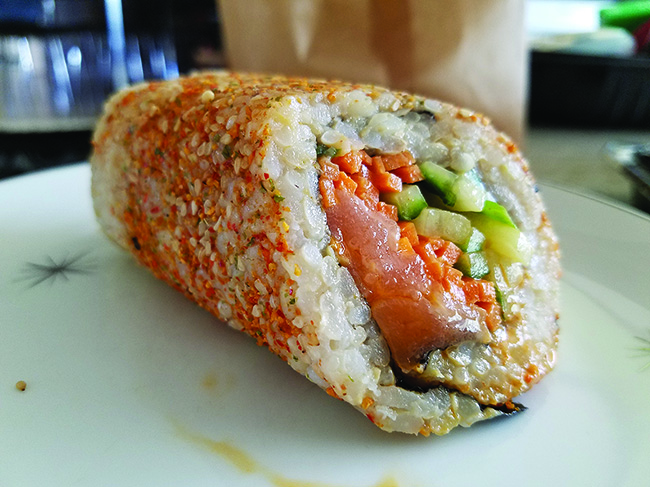
Curry Up Now in San Francisco created just that with traditional Indian flavors of chicken tikka masala, paneer or butter chicken all rolled within a large tortilla. Switch to traditional Puerto Rican flavors filling a large tortilla with gandule (pigeon peas) rice, mashed green bananas or plantains studded with black olives and pernil or Puerto Rican roasted pork. Or Chinese with fried rice, strips of stir-fried pork, beef or chicken and stir-fried veggies in a black bean sauce. The folks at Sushirrito with several locations scattered throughout the Bay Area have already created their own mash-up substituting rice and nori in place of a tortilla but using fillings uncommon in usual futomaki such as raw fish, kabayaki beef and leafy greens to distinguish their product from an uncut futomaki roll.
The Uncommon Bao
Though it’s usually known as bao (bun) or char siu bao (pork filled bun), in the 50th, it usually goes by manapua. Supposedly, the term manapua is derived from the Hawaiian “mea ono pua’a” or “delicious pork thing” which was a dish brought to Hawai‘i by Chinese immigrants who sold them from large cans hung on poles balanced on the vendors shoulders. Eventually, the delivery system turned into vans sold by the neighborhood “manapua man” who also sold roadside candies, snacks and manapua not unlike the neighborhood Mister Softee truck seen stateside. Though the can and pole delivery system was well before my time, I still vividly recall spending my allowance coins (rarely dollars) on manapua and candy once Kapunahala Elementary School released students for the day. And I still mourn the closing of both Char Hung Sut and Libby Manapua Shop, which I considered to have the best manapua in the state.
Like the taco shell or the tortilla, the bao is just a delivery device for some type of meat or vegetable filling so once again, you can create your own ethnic variation on the traditional char siu bao. In fact, Chun Wah Kam with its four locations on O‘ahu offers the usual Chinese fair and traditional manapua as well as fillings such as pizza, garlic chicken, curry chicken, azuki bean and spicy pork. They even offer a hot dog-filled baked manapua!
Bao Recipe
1 package dry yeast
1 & ¼ cups warm water
(~115 F)
1 tsp sugar
4 & ½ cups flour
1 tbsp shortening
1 tbsp sugar
1 tsp salt
Microwave water for ~20 seconds – when temperature is ~115 F, add the tsp of sugar and dry yeast and swirl to combine. When thick bubbles form on the surface, the yeast has activated.
In a large bowl, add the flour, shortening, sugar and salt. Add the yeast mixture and start kneading the dough until a uniform texture is achieved – tacky but not sticky. Place in a greased, large bowl then set aside in a warm area without any draft (I lightly cover and place in a cool oven with the door closed). When the mixture has doubled – 60 to 120 minutes – it’s ready to create stuff. Break off ~golf ball sized portions, flatten to ~1/4 inch then place your filling in the middle and totally seal the filling. Place the pinched off section on the bottom on a 3” by 3” piece of parchment paper then place in a steamer tray about 2” apart from each bun. Let rise for another 60 to 90 minutes then place above moderately boiling water and steam for about 20 minutes.
That’s a Pizza Pie!
Finally, a flattened disk of dough can be the delivery vehicle for any type of topping, not just tomato sauce and cured meats. California Pizza Kitchen started it with that American Italian pizza marriage, the Original BBQ Chicken pizza. That was followed by the Thai Italian Thai Chicken pizza and the Mexican Italian Carne Asada pizza. I’ve been known to regularly bake my own Chinese Italian pizza with a green onion-ginger sauce topped with hoisin, five-spice roasted pork and mozzarella or my Cuban Italian pizza with yellow mustard under chopped dill pickles then topped with chopped Cuban-style roasted pork and shredded Swiss cheese.
So just because there may be cultural or ethnic clashes between humans, food always gets along…
Ryan Tatsumoto is a graduate of both the University of Hawai‘i and UC San Francisco. He is a recently retired clinical pharmacist and a budding chef/recipe developer/wine taster. He writes from Kane’ohe, HI and can be reached at gochisogourmet@gmail.com. The views expressed in the preceding column are not necessarily those of the Nichi Bei News.

The Gochiso Gourmet is a column on food, wine and healthy eating. Ryan Tatsumoto is a graduate of both the University of Hawai‘i and UC San Francisco. He is a recently retired clinical pharmacist and a budding chef/recipe developer/wine taster. He writes from Kane’ohe, HI and can be reached at gochisogourmet@gmail.com. The views expressed in the preceding column are not necessarily those of the Nichi Bei News.




Leave a Reply