
 Though the “Our Gang”/“Little Rascals” comedy series featuring the adventures of a group of children in Los Angeles ended in 1944, well before I was even a twinkle in Dad’s eye, I still recall seeing several reruns of the show. And two characters standout, Alfalfa who had a hairdo like Martin Short’s Ed Grimley persona on “Saturday Night Live” and Buckwheat, who had a bushy mane (and was revived on “Saturday Night Live” by Eddie Murphy with his catchphrase “O-tay”). That brings us to the highlight of this month’s column, the humble grain-like seed of the knotweed family, Fagopyrum esculentum or buckwheat.
Why Buckwheat?
Like many of you, I always purchase dried soba for my traditional New Year’s Eve celebration. I consume a bowl of toshikoshi soba right before midnight to break any of the hardships faced in the expiring year. But I always look for soba that lists buckwheat as the primary ingredient — most brands contain more wheat than buckwheat — because part of the reason for consuming soba instead of somen, udon or any other noodle is buckwheat noodles break easier than wheat noodles, hence the belief that consuming it breaks any bad juju from carrying into the New Year. But this search for buckwheat-predominant noodles often leads me to purchasing soba on multiple occasions before the New Year, then finding those packages in the early months of the New Year. And consuming toshikoshi soba in March or April is jumping the gun quite a bit. So, I needed to find other culinary applications for my abundance of dried soba.
Buckwheat
Though it includes wheat as part of its common name, buckwheat isn’t related to wheat, nor is it a cereal or grass, but due to the high starch content of the seeds, it can be cooked like a cereal. The edible achene or dried simple fruit from buckwheat first needs to be hulled then the whole seed can be roasted to create kasha used in salads or porridges or milled to produce buckwheat flour for soba.
While pure buckwheat noodles are gluten free and can be enjoyed by people with celiac disease or non-celiac gluten sensitivity, the lack of gluten makes the noodles very brittle, as gluten gives noodles its elasticity. So restaurants that serve Juwari soba (100% buckwheat) often make their noodles by hand. Most restaurants serve Hachiwari soba or an 80%/20% blend of buckwheat/wheat noodles. But as I previously mentioned, most dried soba has more wheat than buckwheat in the blend.
Buckwheat is a nutritional powerhouse, with half a cup of kasha containing just 78 calories but 17 grams of whole grain carbohydrates, 2.3 grams of dietary fiber (both insoluble and soluble) and almost 3 grams of protein. It’s also a good source of copper, magnesium and niacin and is a rich source of flavonoids, which have anti-inflammatory and antioxidant properties as well as potential anti-cancer properties.
Though soba is ingrained in Japanese culture, up to 0.25% of Japanese children develop an allergy to buckwheat. While this translates to 1 in 400 children, the symptoms range from mild, with mild rashes, to severe, with asthma symptoms and potentially life threatening as anaphylaxis (airway narrowing and sudden blood pressure drop) so any buckwheat allergy needs to be treated like a peanut or dairy allergy.
Culinary Applications
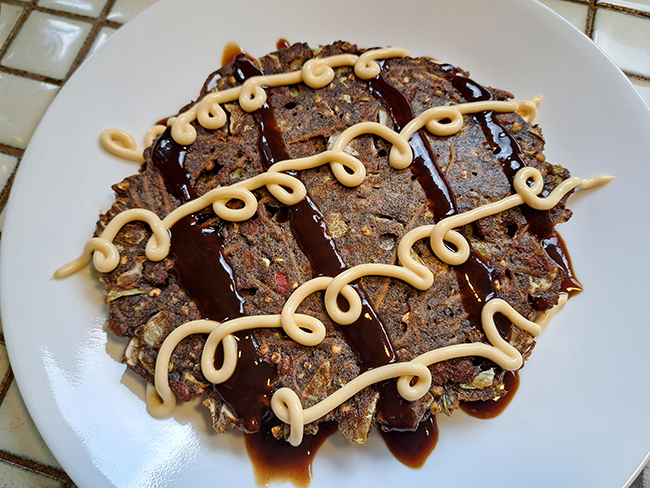
Because soba breaks easier than traditional wheat noodles, you can’t simply add soba in traditional noodles dishes. And if the primary ingredient in your soba is buckwheat, the soba will have a nuttier flavor which may not complement every sauce. So I created this triple buckwheat recipe using cooked soba noodles, buckwheat flour in place of wheat flour and toasted buckwheat groats (buckwheat “seeds” in their natural form) for my version of okonomiyaki — use juwari soba if you want the recipe to be gluten free. My version is vegetarian as it omits the usual dashi katsuo as well as the thin slices of pork belly, but it’s not vegan as it contains eggs and mayonnaise. If you want the traditional carnivore version, add the sliced pork belly and traditional dashi blend. Traditional okonomiyaki batter uses grated yamaimo — because my local markets don’t always have yamaimo in stock, I used the next best mucilaginous ingredient, natto.
Triple O-Tay Okonomiyaki
1 cup buckwheat flour
½ tsp sugar
¼ tsp salt
½ tsp baking soda
¾ cup vegan dashi
3 eggs
1 container natto
2 tbsp beni shoga, roughly chopped
2 tbsp gari, roughly chopped
1 tbsp grated fresh ginger
1 tbsp tamari
¼ cup toasted buckwheat groats
½ cup cooked soba
½ a head of cabbage, diced about ½”
Tonkatsu sauce
Kewpie mayonnaise
For vegan dashi, I steep two shiitake mushrooms and one strip of konbu in water overnight, then just use the clear liquid the next day.
Mix the buckwheat flour, salt, baking powder, sugar and dashi at least several hours (up to overnight) before making the okonomiyaki. Toast the buckwheat groats in a small frying pan on medium low heat, frequently tossing to prevent burning for six to eight minutes then set aside.
When you are ready to make the batter, beat three eggs in a large bowl, then add the natto, chopped ginger mixture mix and tamari then add the buckwheat flour mixture and mix until it resembles a pancake batter — you can add more dashi if it’s too thick. Add the soba and buckwheat groats and mix then toss in the chopped cabbage and mix until the cabbage is evenly coated.
Add a little vegetable oil in a frying pan, then add about a fourth of the cabbage mixture and fry on each side for about five to six minutes on medium heat. After it cools slightly, drizzle with alternating patterns of tonkatsu sauce and Kewpie mayonnaise.
Ryan Tatsumoto is a graduate of both the University of Hawai‘i and UC San Francisco. He is a recently retired clinical pharmacist and a budding chef/recipe developer/wine taster. He writes from Kane’ohe, HI and can be reached at gochisogourmet@gmail.com. The views expressed in the preceding column are not necessarily those of the Nichi Bei News.

The Gochiso Gourmet is a column on food, wine and healthy eating. Ryan Tatsumoto is a graduate of both the University of Hawai‘i and UC San Francisco. He is a recently retired clinical pharmacist and a budding chef/recipe developer/wine taster. He writes from Kane’ohe, HI and can be reached at gochisogourmet@gmail.com. The views expressed in the preceding column are not necessarily those of the Nichi Bei News.





Leave a Reply