
 I was never a fan of most soups as I have what the Japanese refer to as nekojita or cat’s tongue which refers to the inability to consume food that’s still piping hot. Over 20 years ago when the Wisteria restaurant in Honolulu was still operating right up the street from my in-laws, my father-in-law, wife and I ordered their favorite dish, the chicken sukiyaki but because of my sensitive tongue, both my father-in-law and wife almost finished their portions before I could even bring my sukiyaki down to a consumable temperature especially those molten orbs of tofu. Whenever we visit a ramen restaurant, I always order a cold noodle dish and even the miso soup served at Japanese restaurants is tempered by several cubes of ice from my water glass. But since we’re in that brief period in the 50th where temperatures drop into the high 60s or low 70s at night, it’s the only time I’m willing to make a pot of soup since Ms. S loves her soups.
Actually, More of a Stoup
Whenever I make a pot of soup, it invariably gets so much filler that it turns into a stoup or very thick soup. Sometimes, it even turns into an outright stew. Even my annual Oshogatsu ozoni has enough vegetables that it’s more of a stoup than a stew (and yes, I do have to wait quite a while before consuming ozoni due to those molten pieces of mochi). But the way I see it, adding more veggies to any dish is always a good thing as they add vitamins and fiber and I can always get my fluids by simply consuming more water throughout the day. About the only soup that I prepare is miso soup though I guess I can always add more tofu, wakame and daikon to make it a stoup … and I probably will somewhere down the line.
The Three Day Stoup
I first sampled this dish at Poggio in Sausalito, Calif. It’s called Ribollita and starts as a traditional minestrone soup. On the second day, the leftovers are placed in a casserole dish then topped with slices of bread and thinly sliced onions and baked. If there are leftovers, on the third day the bread and onions are mixed in to the thickened stoup at this point then ladled into a skillet to crisp the outer surface. It is then placed on a plate – at this point it has the consistency of thick pancake batter – then drizzled with the newest harvest of extra virgin olive oil. Yes, what started as peasant food and not wanting to waste leftovers (mottainai) has evolved into a soup/stoup worthy of royalty.
Natural Thickening
Sometimes the liquid thickening that turns a soup into a stoup occurs naturally especially when adding starches to the soup. As pasta cooks in the broth, it slowly releases starches that thicken the liquid – that’s why chefs recommend saving some of your pasta cooking water to thicken your pasta sauce. You can simply add cooked and drained pasta to your soup so minimal starch molecules are liberated but I would never do that as pasta cooked in the final liquid whether it’s soup or a pasta sauce naturally flavors the pasta itself as they absorb flavor compounds in the liquid. And precooking your pasta also increases the amount of dishes you need to wash once you’re done.
Canned beans also naturally thicken liquids as legumes also contain a fair amount of starch – just look at the consistency of the liquid before draining a can of beans. That liquid is almost as thick as soups that are thickened with roux (cooked flour and butter) or cornstarch. So even if you don’t intentionally thicken the broth in your soup, certain ingredients will do that for you.
My Standby Stoup
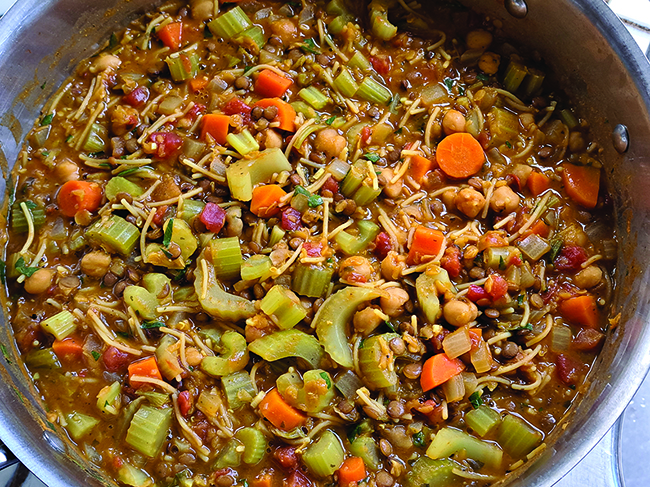
I first included a variation of this recipe in a column that went to press more than 20 years ago. In that time, I’ve changed some of the ingredients, upped the spices and renamed the dish as the original was a vegetarian Harira, a traditional North African dish Muslims consume to break the fast during Ramadan. Since my version is more stoup than soup and I don’t have any North African heritage, I renamed it based on what it is, a vegan stoup that’s chock full of protein, fiber and flavor.
Veggie and Bean Stoup
1 tbsp olive oil
2 peeled carrots, quartered lengthwise and chopped to ½ inch
3 stalks of celery, quartered lengthwise and chopped to ½ inch
1 large onion, chopped to ½ inch dice
2 to 3 garlic cloves, minced
1 can of rinsed and drained garbanzo beans
1 can of rinsed and drained black beans, navy beans or pinto beans
1 tbsp curry powder
1 tsp ground turmeric (if no turmeric add 4 tsp curry powder)
1 tsp ground cinnamon
Two 14 oz cans of peeled, chopped tomatoes with liquid
3 cups of water or vegetable broth
Salt and black pepper to taste
1 cup of dried lentils
½ cup of dried Barilla Protein + Angel Hair pasta broken into ½ inch pieces
1 bunch of fresh chopped parsley (about 1 to 1 & ½ cups)
1 large bunch of fresh chopped cilantro (with stems if you like cilantro like I do)
In a large Dutch oven, sauté carrots, celery, onion and garlic in olive until softened – about 5 minutes. Add beans and spice powders and cook about 3 more minutes. Raise heat and add tomatoes with liquid, water (or broth) and salt/black pepper and bring to boil. Add lentils then reduce heat to simmer (with Dutch oven partially covered) for 20 minutes. Add pasta and simmer for 10 minutes. Add parsley and cilantro and simmer for 5 minutes.
Because this stoup has no animal fat, it can be consumed hot, warm or my preferred temperature … straight from the refrigerator.
Ryan Tatsumoto is a graduate of both the University of Hawai‘i and UC San Francisco. He is a recently retired clinical pharmacist and a budding chef/recipe developer/wine taster. He writes from Kane’ohe, HI and can be reached at gochisogourmet@gmail.com. The views expressed in the preceding column are not necessarily those of the Nichi Bei News.

The Gochiso Gourmet is a column on food, wine and healthy eating. Ryan Tatsumoto is a graduate of both the University of Hawai‘i and UC San Francisco. He is a recently retired clinical pharmacist and a budding chef/recipe developer/wine taster. He writes from Kane’ohe, HI and can be reached at gochisogourmet@gmail.com. The views expressed in the preceding column are not necessarily those of the Nichi Bei News.





Leave a Reply